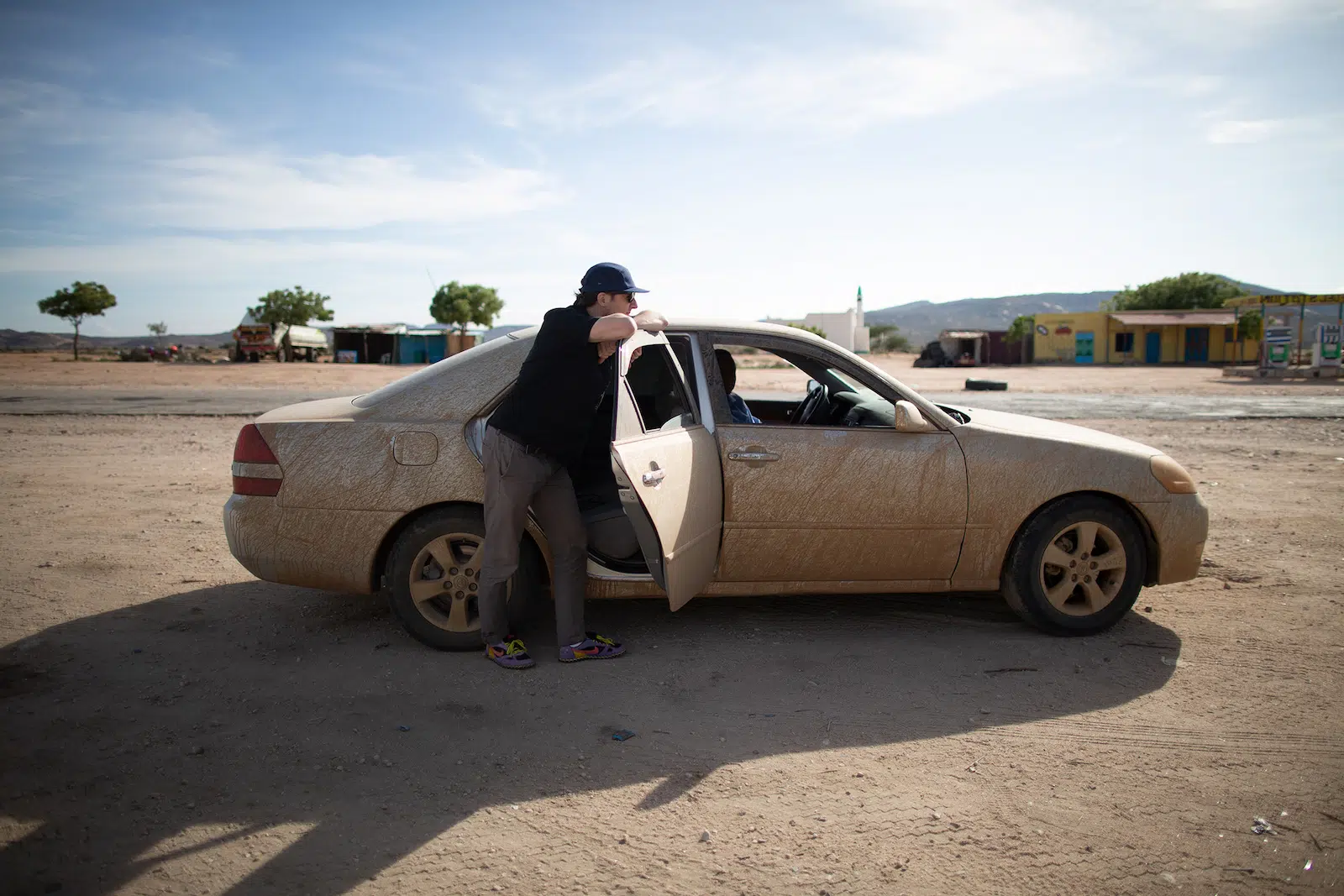
Photography by Jan Chipchase, 2015
Biography
Pascal Wicht is a strategic designer and discovery researcher, specialized in interventions that require oscillating between individual issues and broader societal challenges at higher levels of complexity. His work ranges from sense-making and rapid ethnographic deep dives to rich future scenarios and mapping innovation tracks.
He works on the systems societies depend on and cannot switch off. His current terrain is financial infrastructure read at every scale it operates, from household money practices to sovereign monetary architecture, with a particular emphasis on the social dynamics that underpin use and value. The fieldwork runs across Africa, Southeast Asia, Latin America and Europe, and the comparison between them is where the value sits.
The second half of his practice is creative direction. Pascal builds speculative worlds with their own economies, materials and rules, rendered with enough specificity to stand inside. The fieldwork feeds the world building, and what he finds on the ground is consistently stranger and more particular than anything he would have invented at a desk.
Pascal’s life has always been about navigating multiple worlds. Born amidst the serene meadows of Switzerland’s Pays de Vaud and shaped by the vibrant energy of African cities like Maputo and Johannesburg, Pascal has spent his life at the crossroads of diverse cultures and ideas. His early encounters with the stories of African activists, tales of injustice, Apartheid, displacement and resilience, ignited a deep interest in identity and belonging, shaping his global perspective.
The deepest of those crossings happened at home. Pascal has spent decades inside a Vietnamese family, not as research, as life. He kept reaching for his own grammar of what a person owes, what is said and left unsaid, what care looks like, and kept being quietly wrong in ways no field method would have surfaced. Nobody theorises their way out of reading another world as a stage of their own. You get worn out of it slowly, by people who love you and do not run on your operating system.
Pascal’s career began as a graphic designer in Johannesburg, and his path has taken an unusual shape since. Over three decades he moved through UX design and branding into creative direction, winning awards along the way, and then out the other side. Each move was made early, before the field had crowded, which is the same instinct that now takes him into the field before anyone has written a brief.
Traditional design approaches proved insufficient for the problems he was being handed, so Pascal turned to strategic foresight and field research. He read his way into critical social sciences, cultural anthropology and political economy, and put them to work in the field rather than in a seminar. The practice that came out of it is oriented toward emerging imaginaries: the new ways of thinking and being that shape what comes next.
Since 2020 Pascal has worked with a Swiss family-owned global leader in security inks and authentication solutions, across strategy, R&D and market-facing initiatives with government and institutional clients. He is currently their futurist in residence and field researcher, running a multi-country research programme on cash and payment ecosystems.
In 2018 Pascal founded Whispers & Giants, a Swiss practice dedicated to helping innovators and change-makers envision and work toward preferable futures. He works alone in the field and assembles teams when the problem calls for capabilities he does not have, drawing on a network built across three decades and four continents.
Outside his professional activities, Pascal spent a decade teaching swimming to children with water phobia, helping them overcome fear through breathing techniques and play. He also worked with learners of varying abilities and with older adults.
Pascal teaches as a clandestine academic lecturer at ECAL, where he runs courses on design research, future thinking and creative futures. He has previously taught at HEC Lausanne and HEG Geneva. His teaching and his practice reflect a commitment to preparing today’s students for tomorrow’s wicked problems.
First written by Juliette Delattre in 2019, revised since.
Based on an original text by Juliette Delattre, in 2019.