The Hidden Sungemite Archipelago
Generative Photography
Speculative Ethnography
Whispers & Giants
Explore, Imagine, Transform
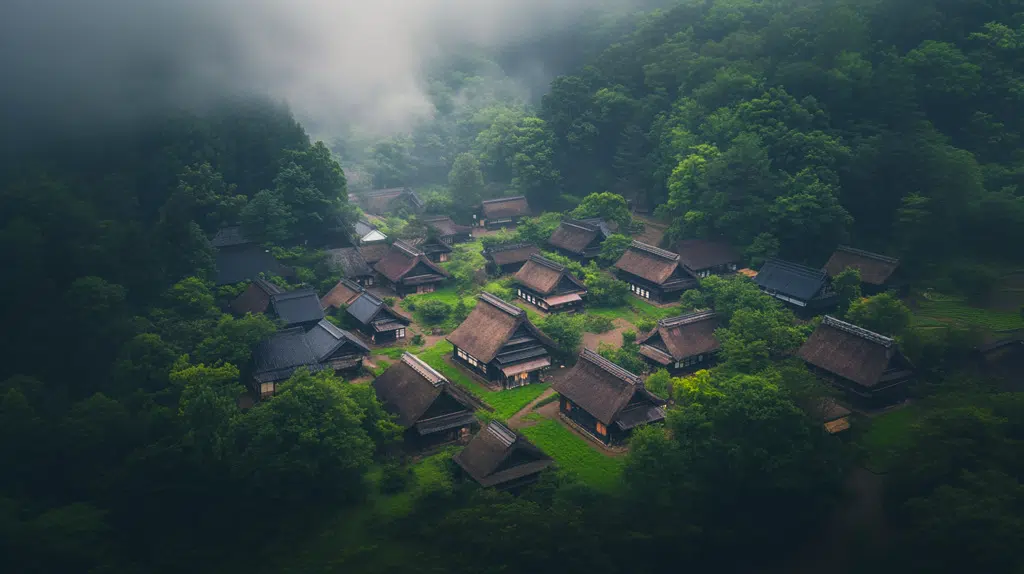
Sungemite Archipelago, a Whispers & Giants explorations
Artificial intelligence & crafting speculative ethnographies of energy, healing, and place.
A Generative Artificial Intelligence Exploration
Diffusion models as speculative ethnographic instruments: toward a practice of AI-assisted world-building as personal epistemology.
A speculative civilization on a volcanic archipelago, where geography is the primary cognitive infrastructure and Sungemite, a rare mineral with photovoltaic and electromagnetic properties as material foundation.
A society organized around what the land offeres. Conducting energy rather than extracting it, reading terrain rather than overriding it. The images were generated with MidJourney at high style values, holding the line between plausible and strange.
I was working on this project last year, when I attended a panel on creativity and AI at Plateforme 10 in Lausanne. Back then, I wasn’t happy with some images, which prevented me from finishing it. A few images needed some clear fixes to be usable. I did use some images to illustrate my practice, without ever showing more. Almost a year later, Nano Banana was very helpful to finalise and once for all end this project. This page is the result.
I lived with long Covid for three years. Chronic pain, especially a double-sided sciatica and the kind of depression that arrives like waves of cognitive shadow of a body stuck in a loop it can’t exit.
With luck, my path crossed a blind Vietnamese electro-acupuncturist in Saigon, a master trained in Japan. No needles. Tiny electrical pulses on acupuncture points through the skin, modulating pain pathways, autonomic tone, inflammation. I left those sessions without pain for the first time in years. Rediscovered sleep.
This experience seeded this project. A speculative civilization built around a mineral that stores, conducts and returns energy. A society that learned to read what the land was signaling before it thought to extract it. The logic is the same. Find the current, listen to the pattern, offer the system a frequency it can reorient toward.
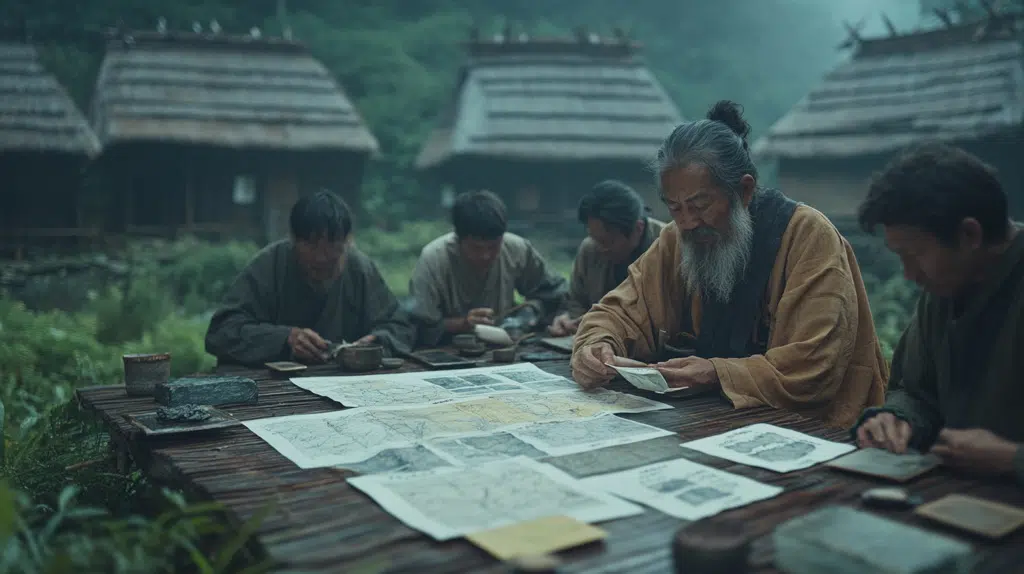
The mountains structure everything. Water, Sungemite, governance and symbolic life all originate there, encoded over generations into maps that accumulate meaning as they pass through hands and seasons.
Each resident carries a personal cartography, built through years of crossing, witnessing and returning, considered too individually calibrated to be borrowed. Maps are shared openly, even displayed and compared with pleasure, but using someone else’s to navigate would strike a resident as absurd, the way wearing someone else’s prescription glasses might.
Navigators earn access to these personal geographies slowly, through trust and read the discrepancies between them as a diagnostic of the community’s collective orientation and a fertile space for inspiration.
Terrain, here, is a form of intelligence that only becomes legible in the plural layering of time.
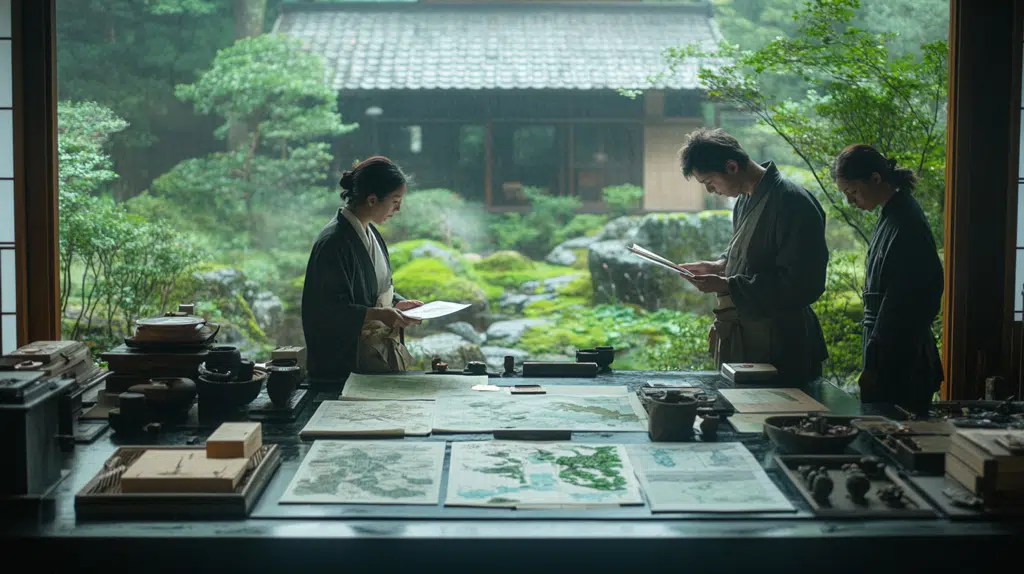
Our hosts, morning rain. Their work is Sungemite discovery mapping: new deposits, shifted fields, sites that need a first notation or a corrected one. The garden is wet behind them. This is what they do before breakfast.
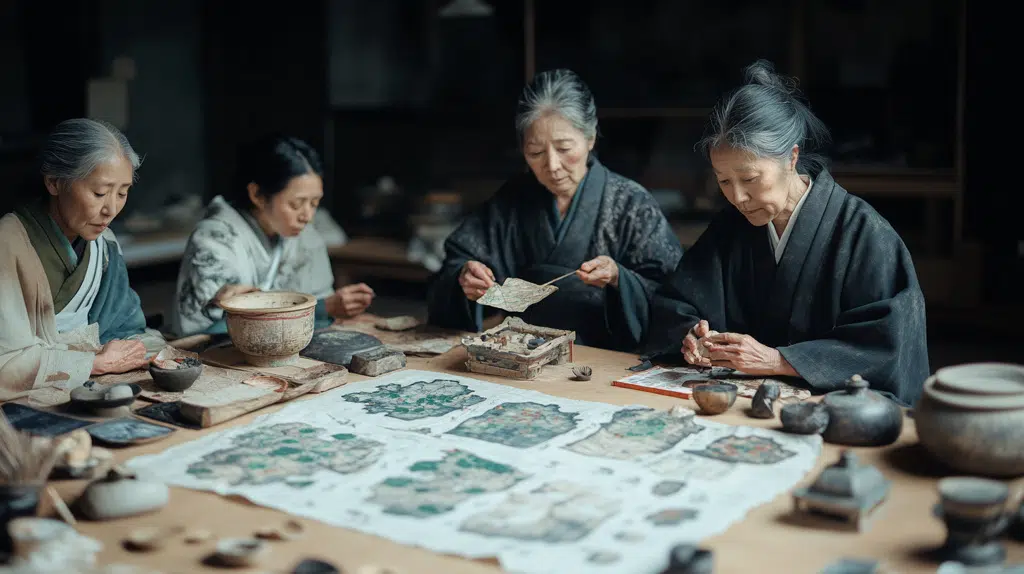
Four senior cartographers, late afternoon, restoration session. The maps on the table are old enough to have lost their edges. The work is to read what the damage has left and decide what gets restored and what gets kept as it is, the erosion itself now part of the record. They have been doing this together long enough that nobody needs to explain what they are looking for.
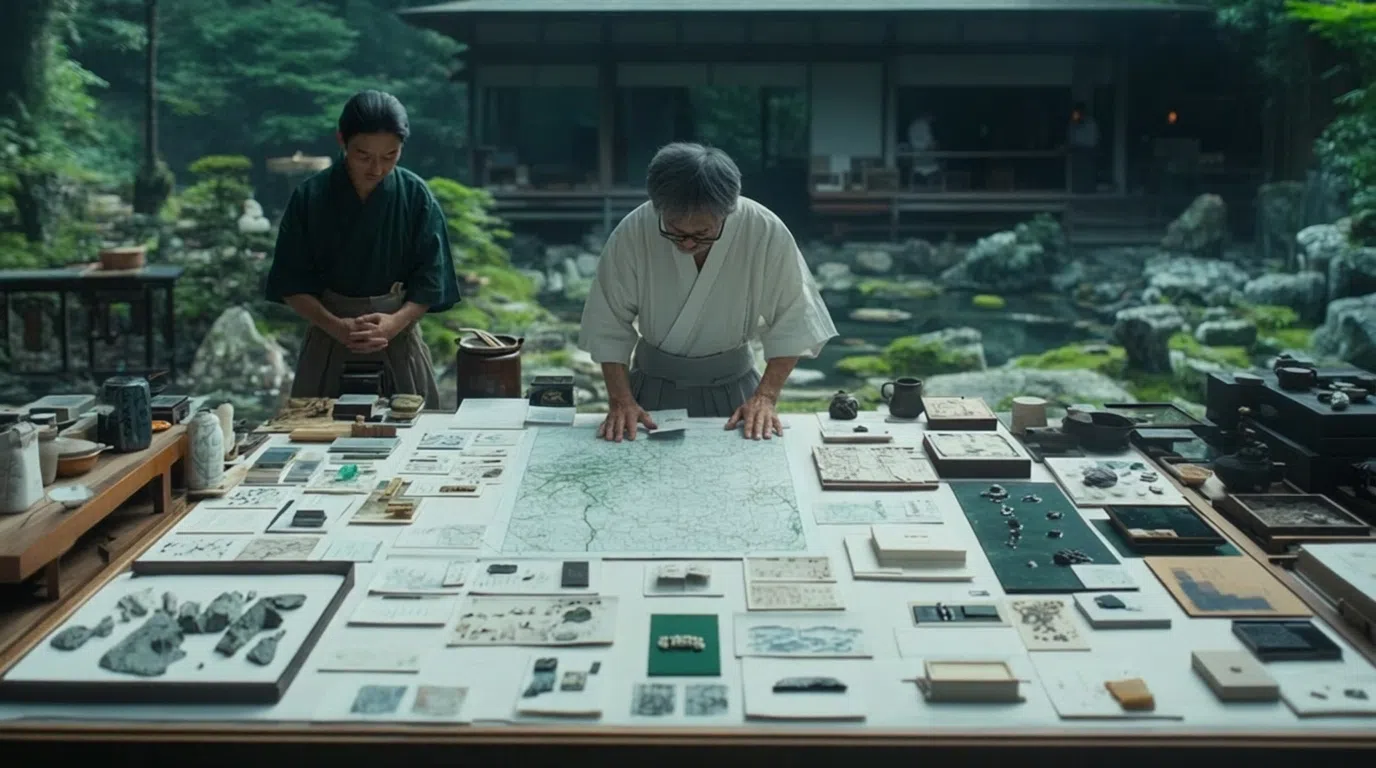
Teva Ishikawa and his student.
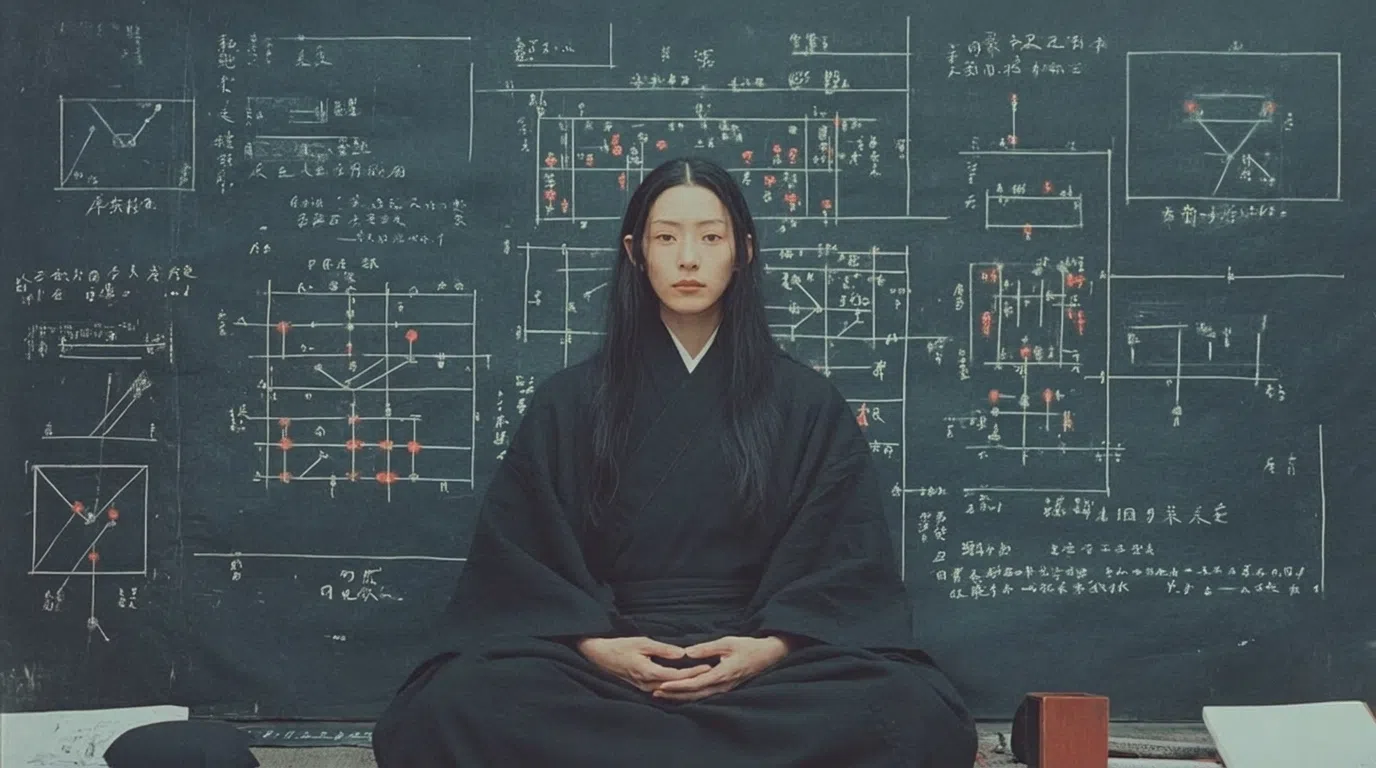
Nalu Shimizu, Umikaze, working session. The diagrams behind her are field notations tracking Sungemite conductivity across terrain at different seasons. The red points mark where the signal shifts unexpectedly. She was the first to understand that the shifts follow water, not rock: Sungemite conducts differently depending on the moisture gradient moving through the substrate beneath it, which changes everything about how the archipelago’s energy fields are read and mapped.
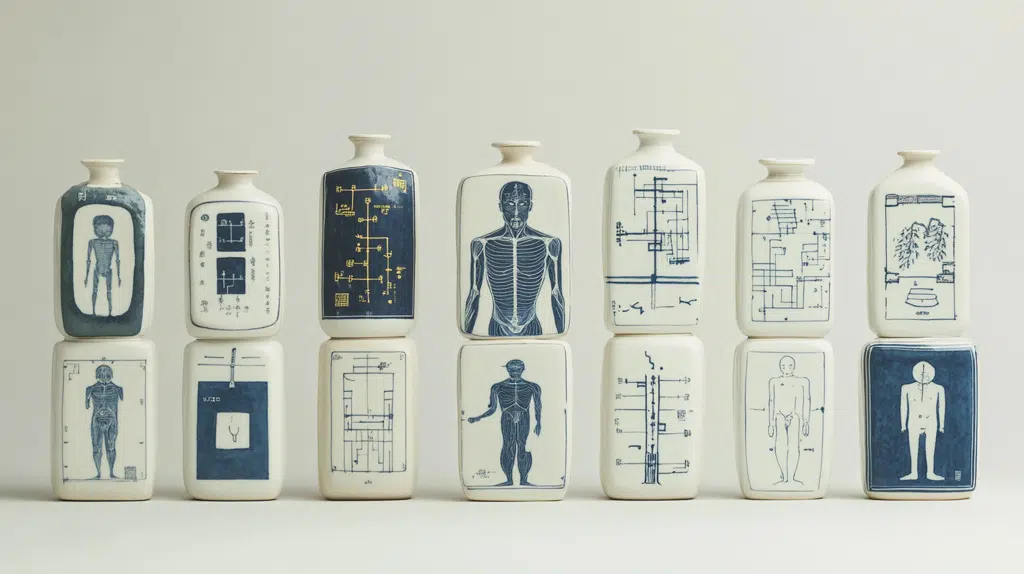
Ceramic vessels from Nalu Shimizu’s personal collection, each fired with field diagrams and body maps from different periods of her practice. The nervous system renderings and circuit notations sit on the same surface without hierarchy. She has always treated the body and the terrain as the same kind of problem.
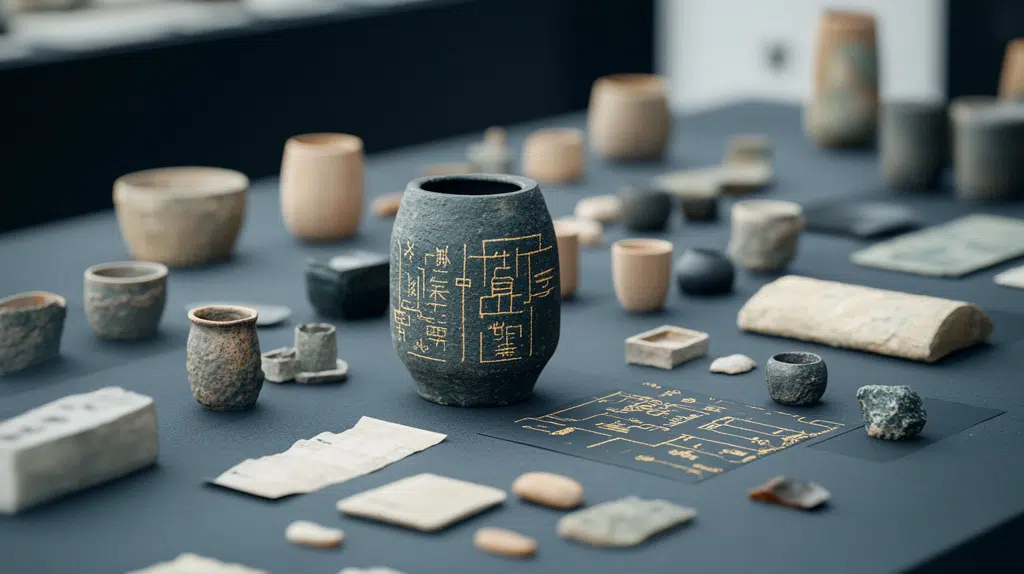
Hiro Manu Okada’s working table, Umikaze. He collects fragments: worked stone, early ceramic, field notes on paper that has started to separate at the folds. The dark vessel at the center is Sungemite-bearing basalt, inscribed with conductivity notations in a hand that predates his own. He found it three hours up the northern slope. He has not decided yet whether it belongs to him.
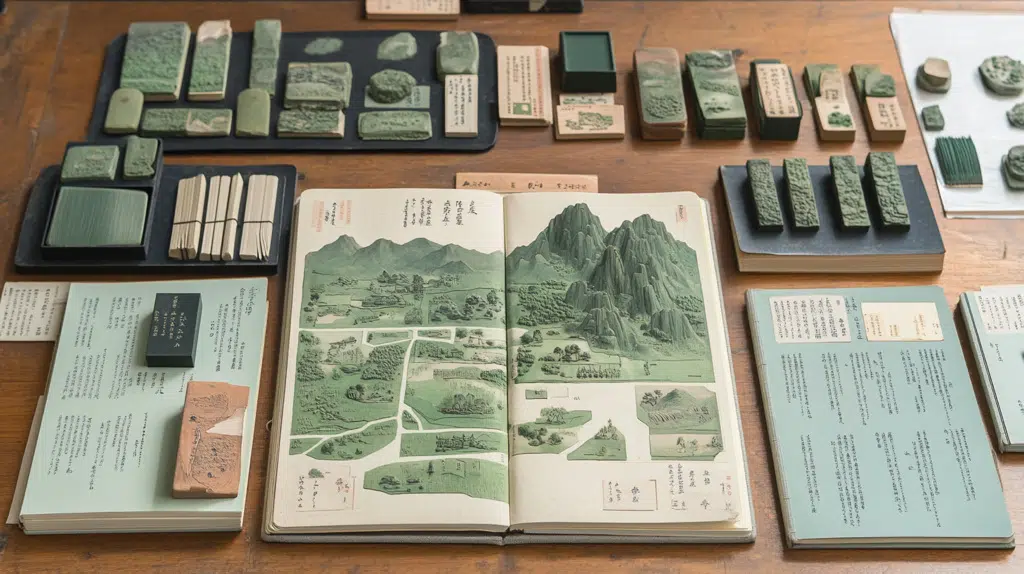
From a woman who wishes to stay anonymous, from the mountain village of Takaumi. The open notebook shows a personal terrain map, relief rendered by hand in layers of green ink, the kind of work that takes years to read correctly and a lifetime to make. The Sungemite stamps along the edges were cut to mark conductivity zones. She uses them the way others use a compass.
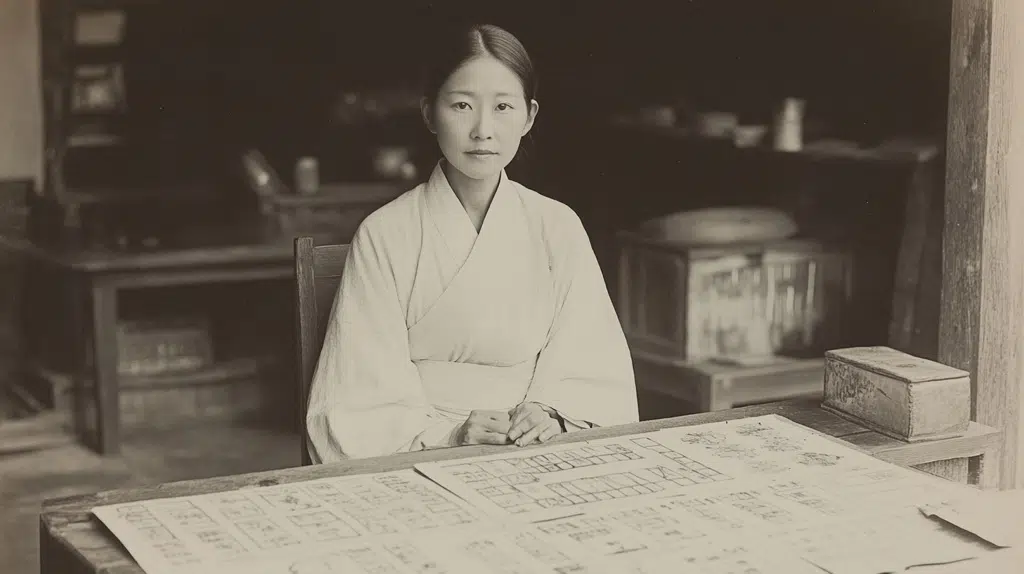
A visitor passed through Umikaze sometime in the early decades, name unrecorded. They left no account of the archipelago, honored whatever agreement had been made. What remained were a small number of portraits, distributed quietly among the families photographed. No one knows how many were taken. This is one of them.
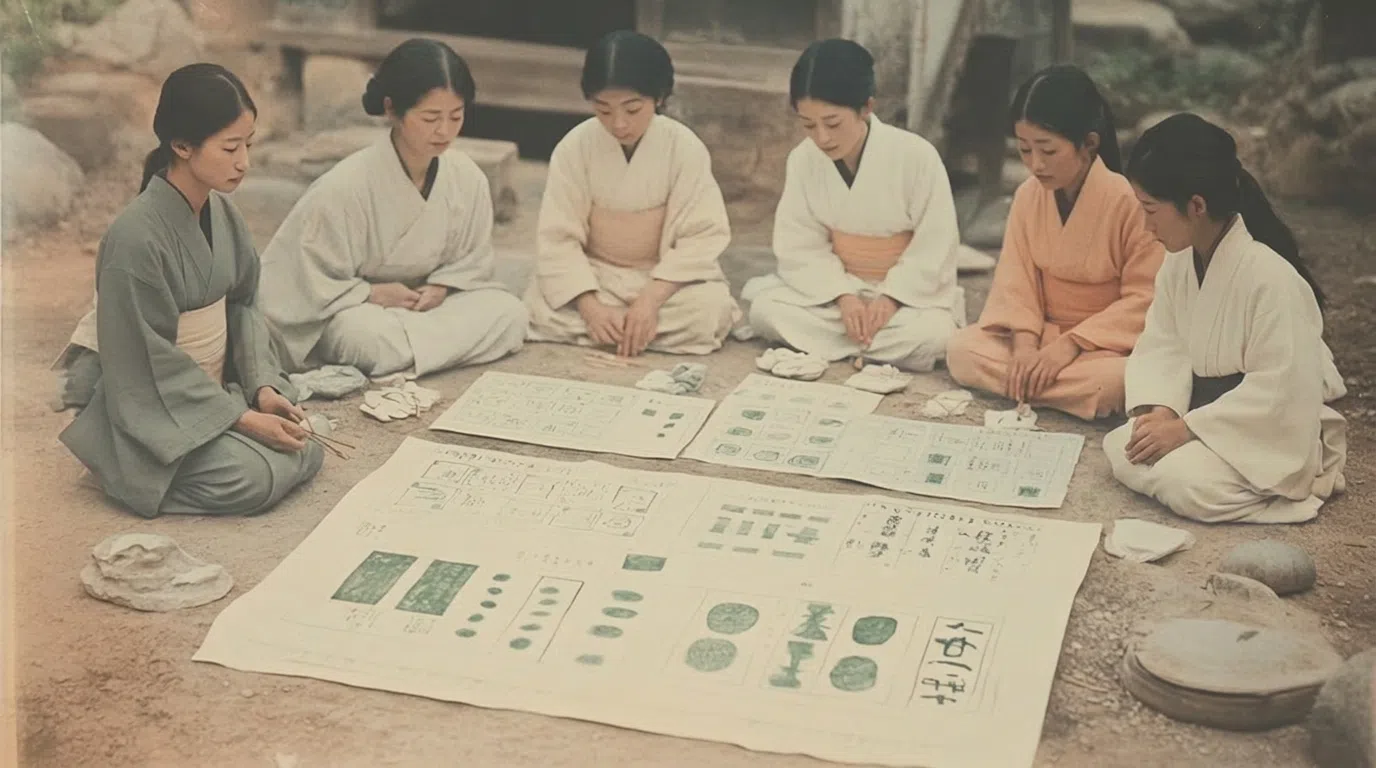
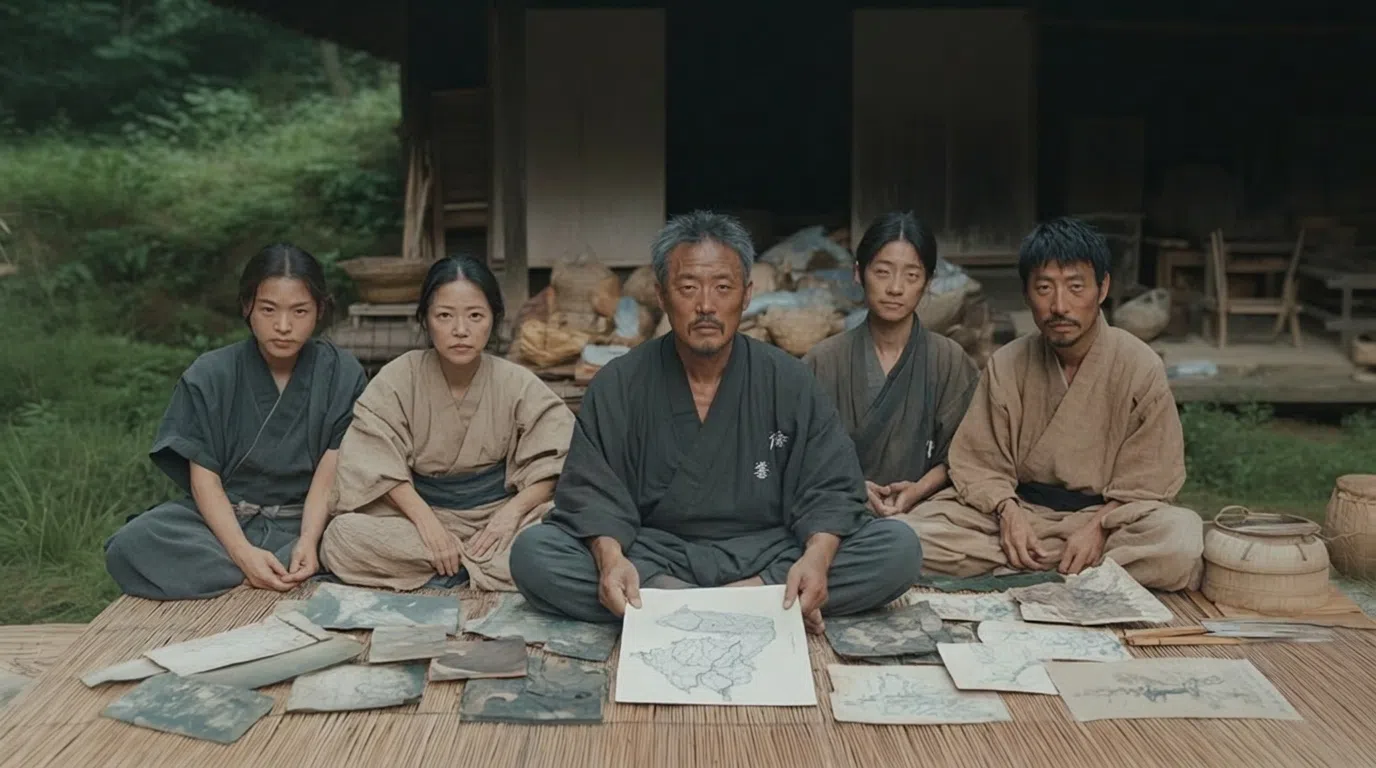
A Sungemite classification session, outdoor, no date. The sheets on the ground catalogue sample variations by color, conductivity and provenance. The stones passed between hands as the discussion moved. The photographer was sitting just outside the circle. She has never left the island and has no plans to.
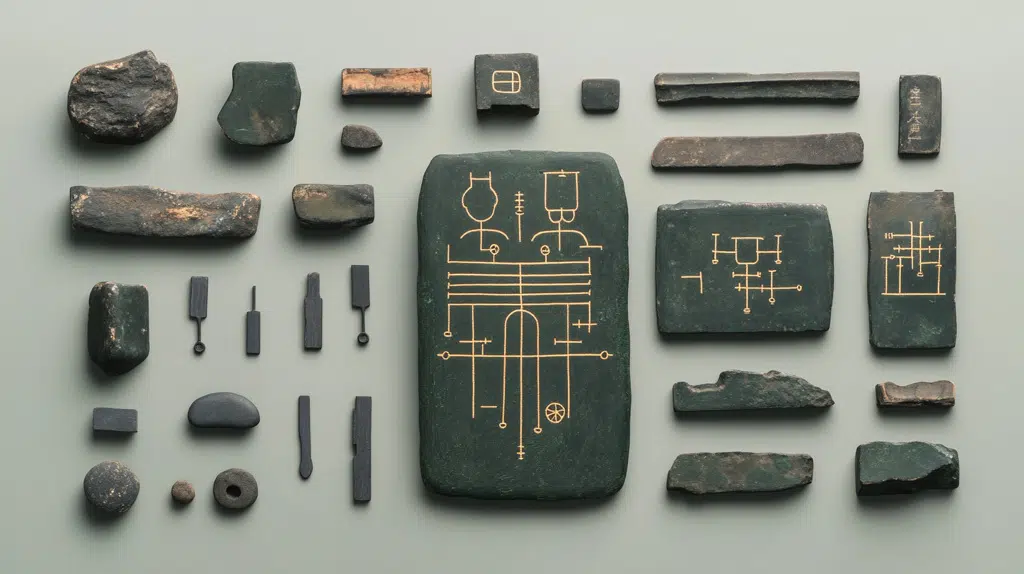
Sungemite fragments, northern slope provenance, arranged by Hiro Manu Okada over several field seasons. The central tablet is the oldest known inscribed piece: a circuit diagram for a two-body treatment, gold-inlaid, origin disputed. The smaller rods and discs are working instruments, worn at the contact points. The raw fragments along the edges have not been assessed yet.
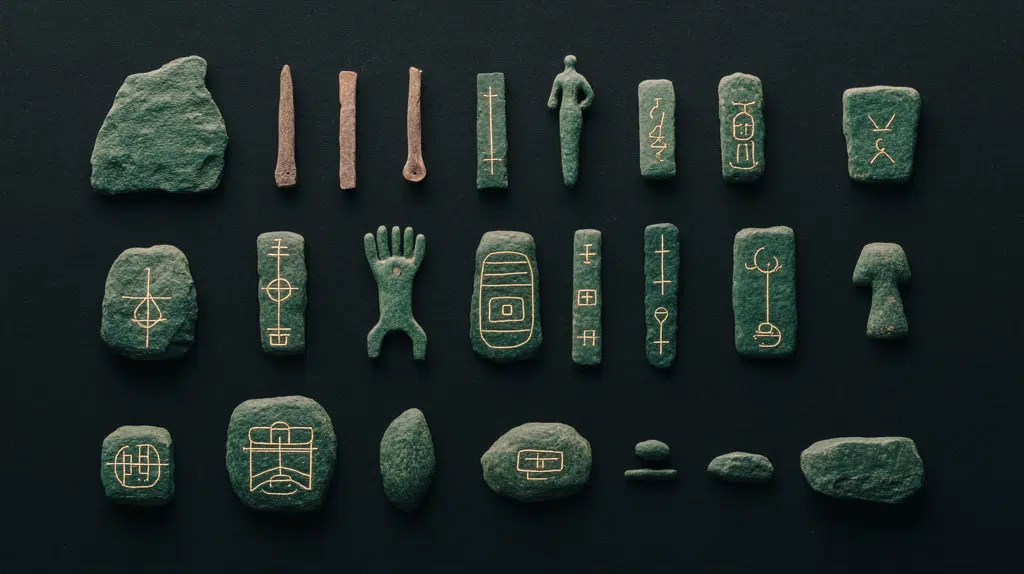
Emerald Sungemite, ceremonial and diagnostic instruments, mixed provenance. The figural pieces, a standing body, an open hand, map treatment points and relational positions. The inscribed tablets carry notations whose reading is still contested: some argue they are dosage records, others that they index conductivity by body zone. The smooth uninscribed stones at the bottom are the most recent additions. No one has marked them yet.
Knowledge here is held in objects before it is held in language. The body and the instrument are part of the same notational system. Contested readings are a condition to maintain.
The archipelago has no tradition of fixing a single authoritative interpretation and these tablets have survived precisely because no one won the argument. Touching a rare thing daily is a philosophical position.
What holds this together is a knowledge culture that is neither reverent nor relativist. Interpretations are tested, revised and sometimes abandoned. Complexity is faced directly, without the consolation of premature closure.
The system assumes that what is currently understood is always a partial account of something larger than the tools available to read it.
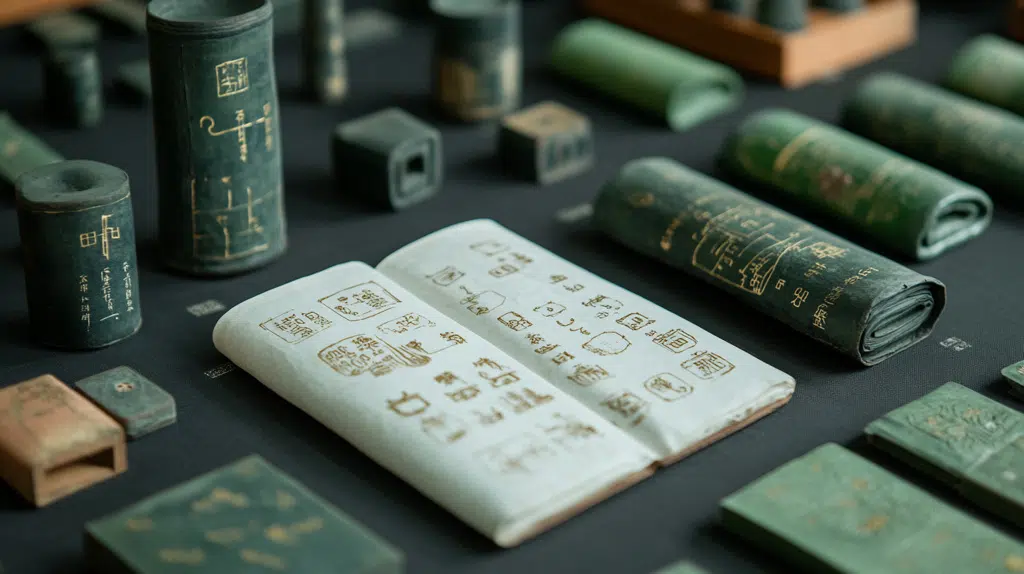
Field instruments and annotated scrolls from the Umikaze commons, one of several shared repositories distributed across the archipelago where objects, notations and working documents are held collectively. The distinction between archive, school and gathering place does not translate cleanly here. Objects arrive, are studied, are sometimes taken out for use and returned. The Sungemite cylinders along the back are lending instruments. The open scroll is a working document, still being added to. This is beyond preservation. It is a conversation that has been going on for a very long time.
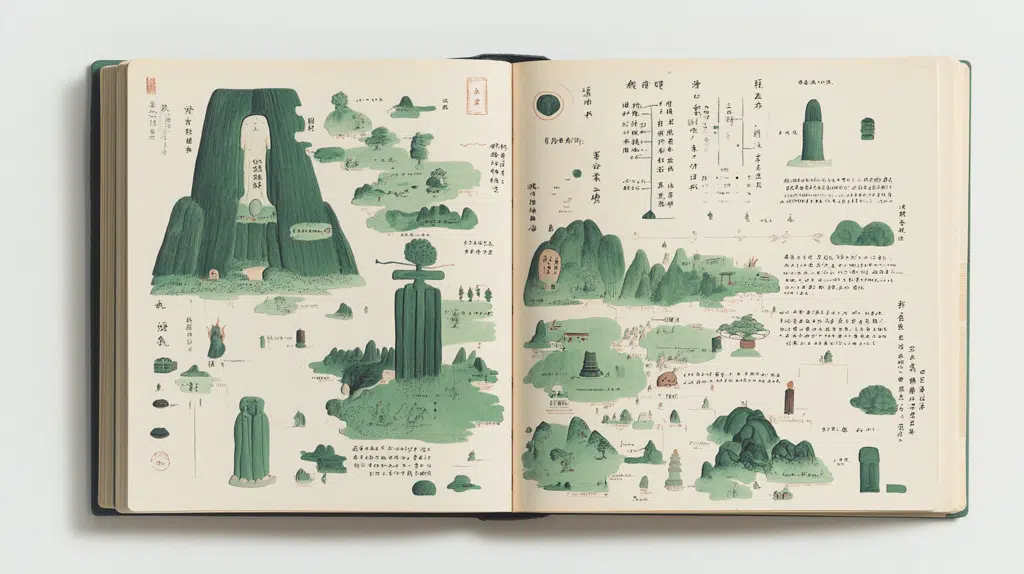
A field atlas from the high commons of Shimahara, compiled over forty years by a rotating group of practitioners who never agreed on a single method. The left page maps Sungemite outcrops in relation to the volcanic formations above them, each deposit drawn at the scale of its significance rather than its physical size. The right page is a relational index: which sites respond to which seasons, which formations have changed since the last survey, which ones the mountain seems to be withdrawing. It is made because the terrain keeps moving and someone has to keep up with it.
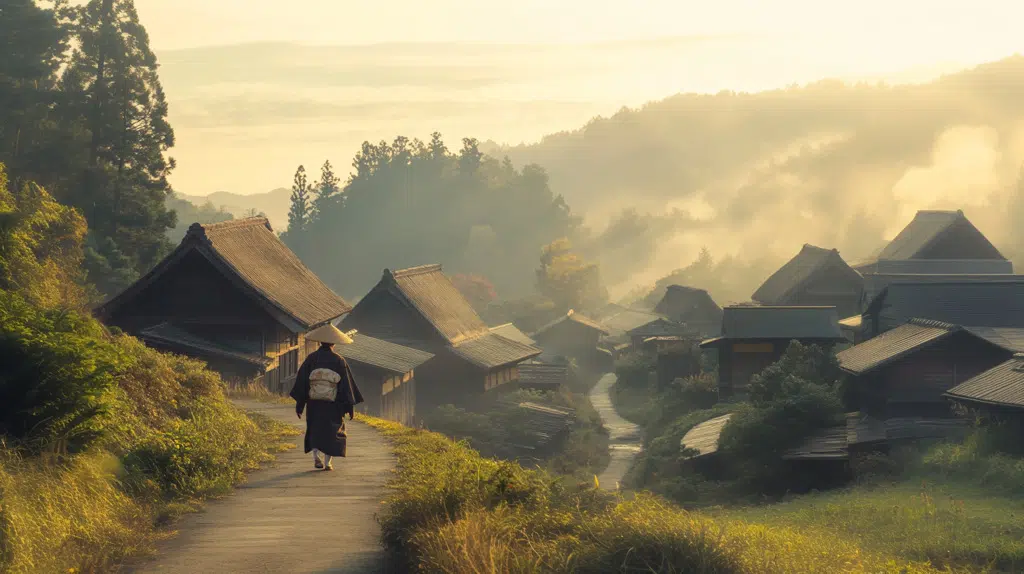
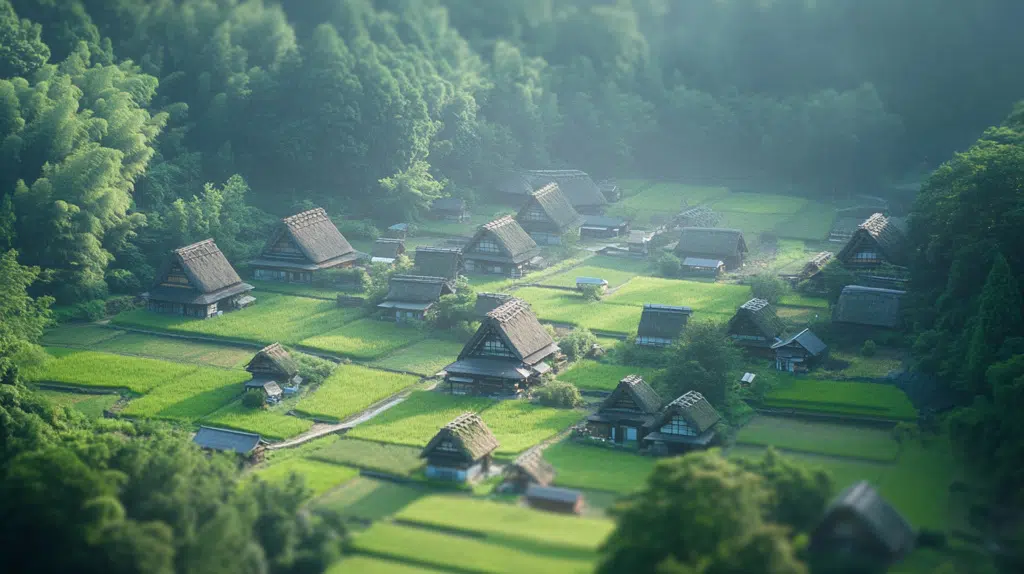
Fog still sitting in the valley, rice just beginning.
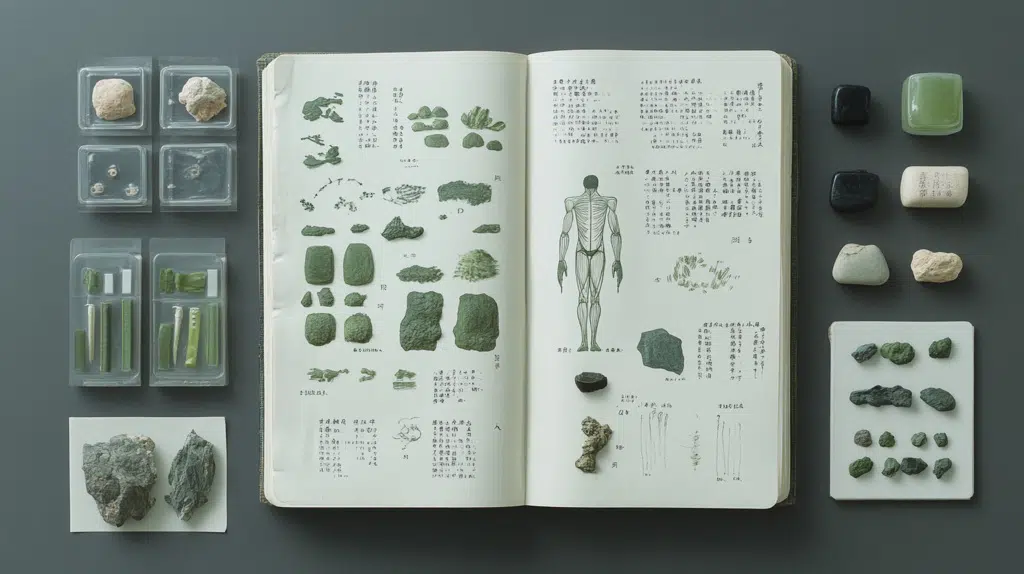
A practitioner’s working notebook, open to the page where the mineral taxonomy meets the body. The left side catalogs emerald Sungemite fragments by texture and provenance. The right side is a muscular diagram with notations that do not correspond to any known treatment protocol currently held in the commons. The sealed specimens along the left edge are still in use. We were shown this on the second day. We still are not sure why.
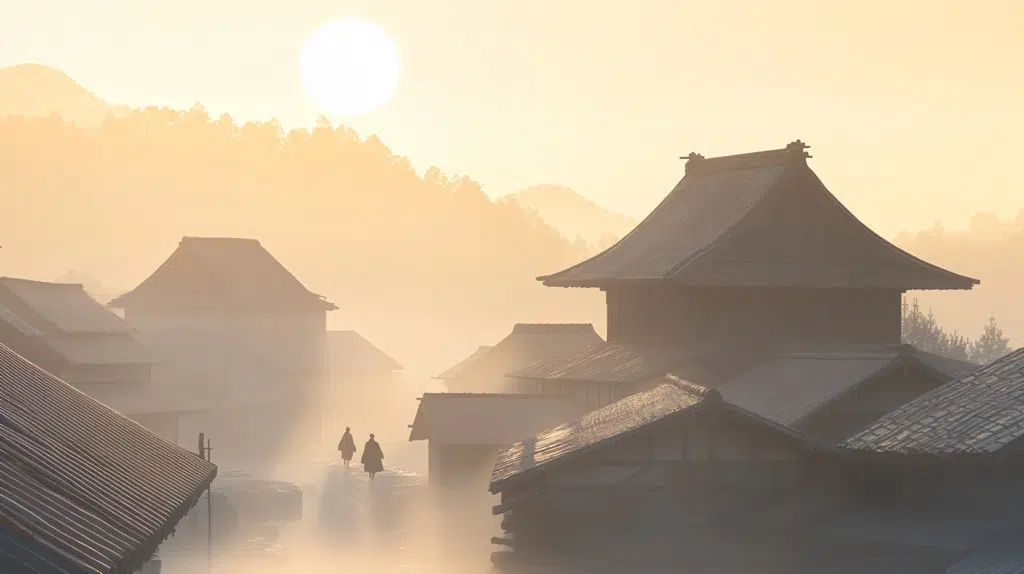
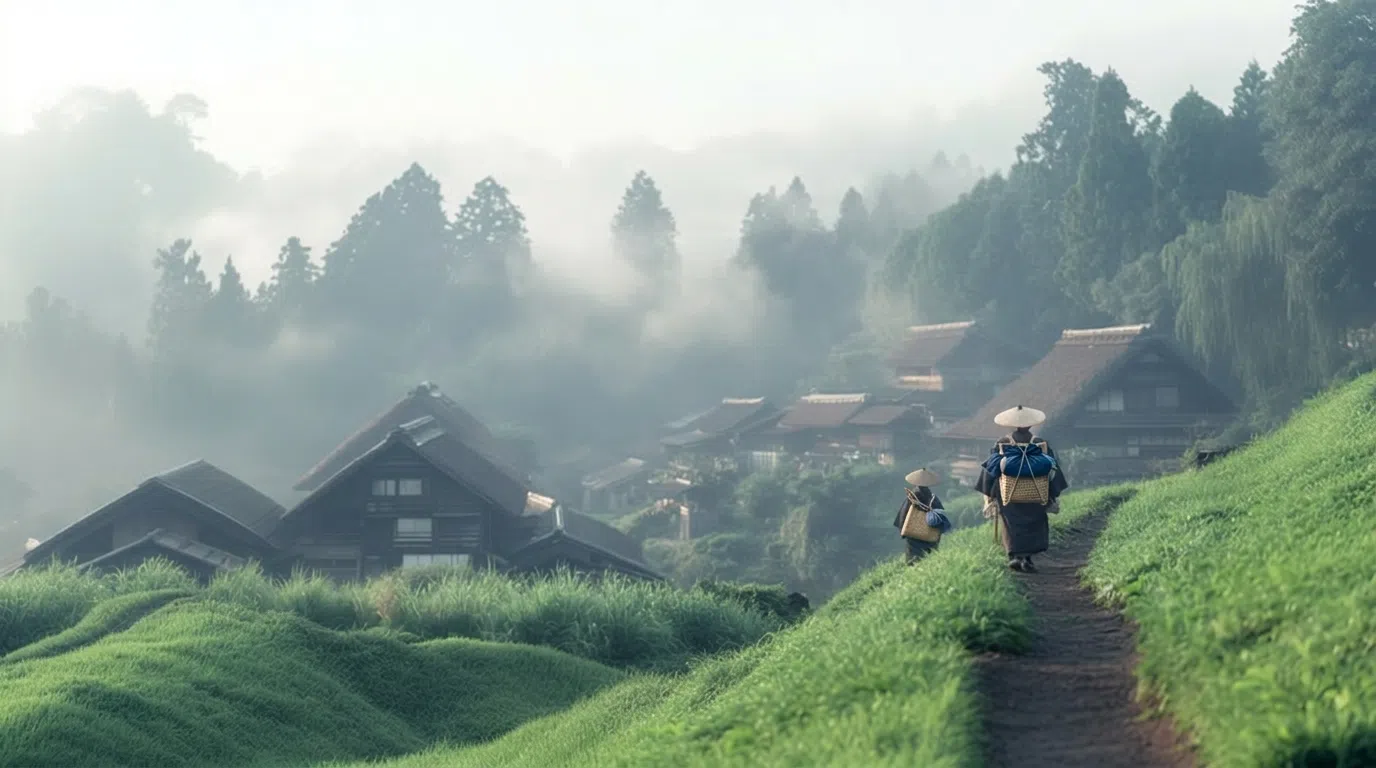
Two figures crossing at dawn, the town not yet distinct from the haze.
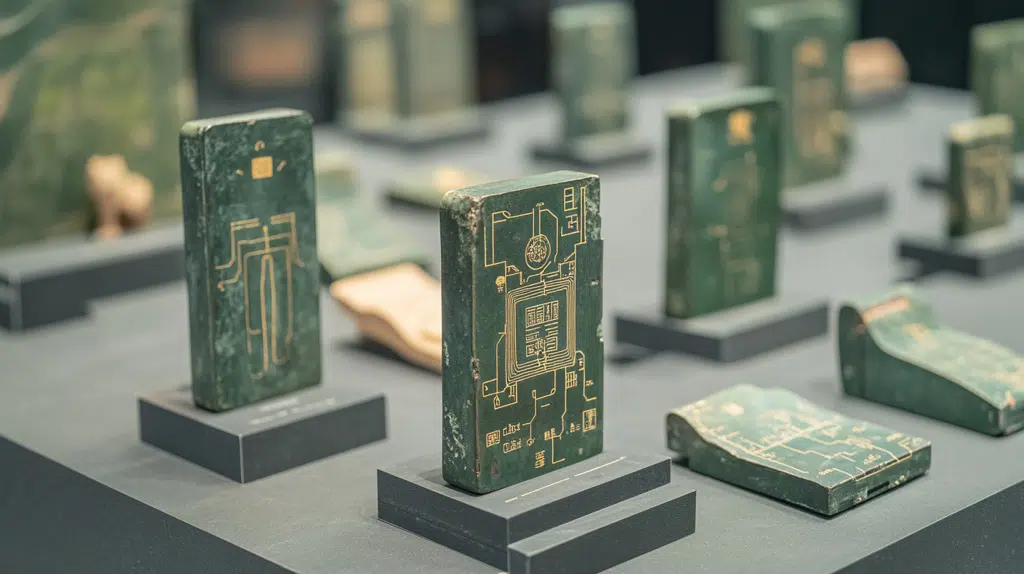
Emerald Sungemite tablets, private collection, coastal clan, mother island, provenance undisclosed. The gold inlay carries circuit notations of a type not found in any commons holding. The family has never explained where the system comes from. They have also never been asked twice.
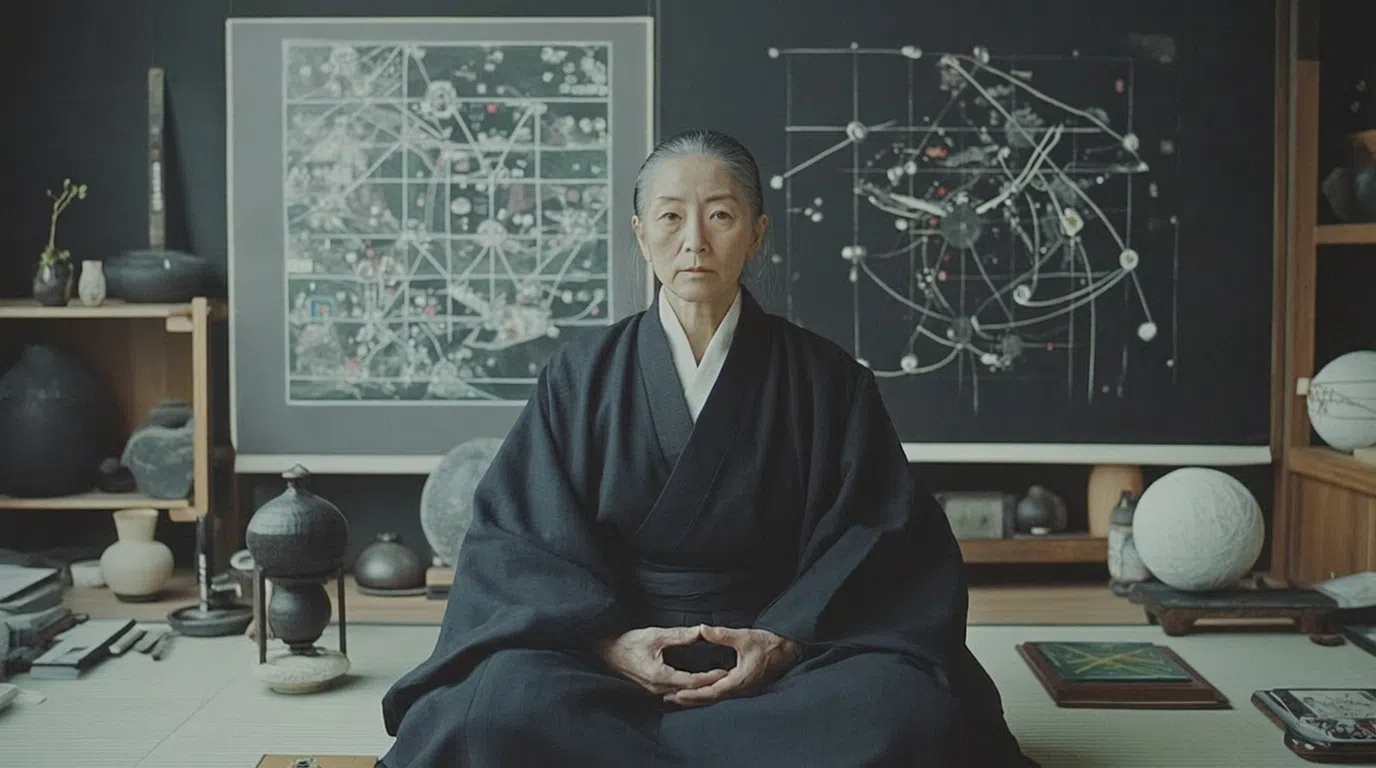
Nalu Shimizu, Umikaze, current. Behind her, two systems: the grid map on the left tracking Sungemite field distributions across the northern archipelago, the orbital diagram on the right mapping conductivity pathways through the body at the scale of a treatment session. She has spent forty years arguing they are the same diagram. At this point, very few people disagree.
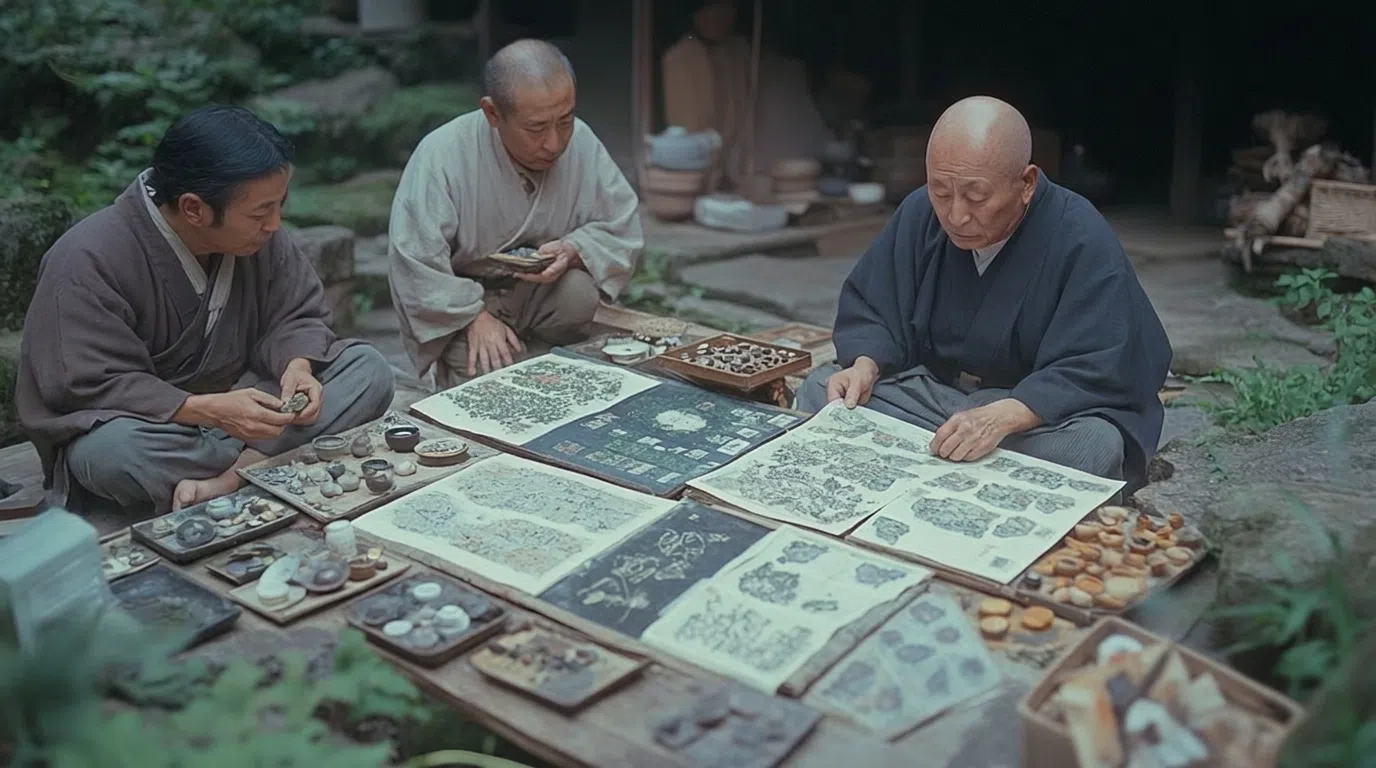
Eastern island collectors, afternoon, open courtyard. Each stone is placed where it is because of where it came from: a name spoken quietly as the hand opens, the stone finding its position among the others the way a word finds its place in a sentence already half-written by the land. What looks like arrangement is closer to introduction. The stones are meeting each other in the order the mountain released them.
There are three places in the archipelago where the full corpus of Sungemite medical knowledge is held. We were permitted to enter one. The condition was that we would not say which island, which valley, or whose family maintains it. What follows is what we were allowed to document.
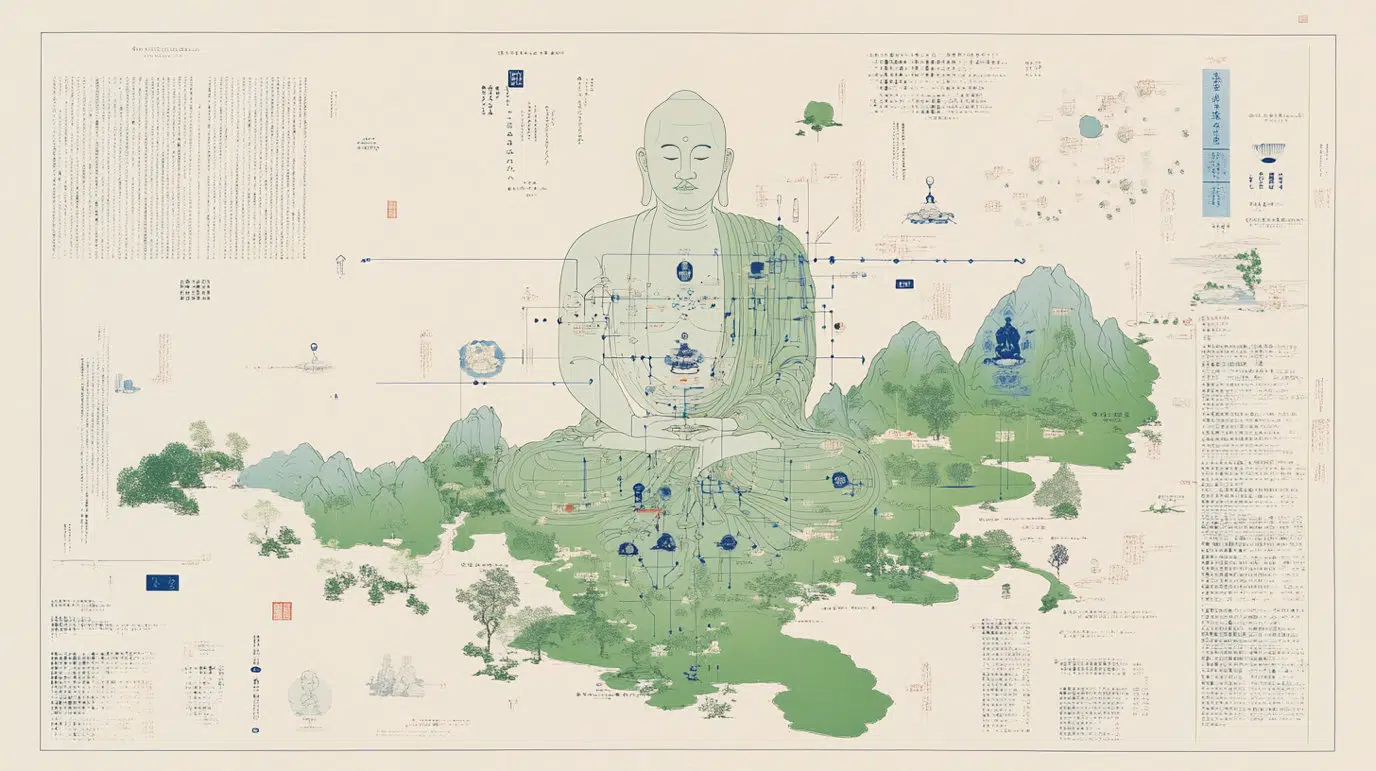
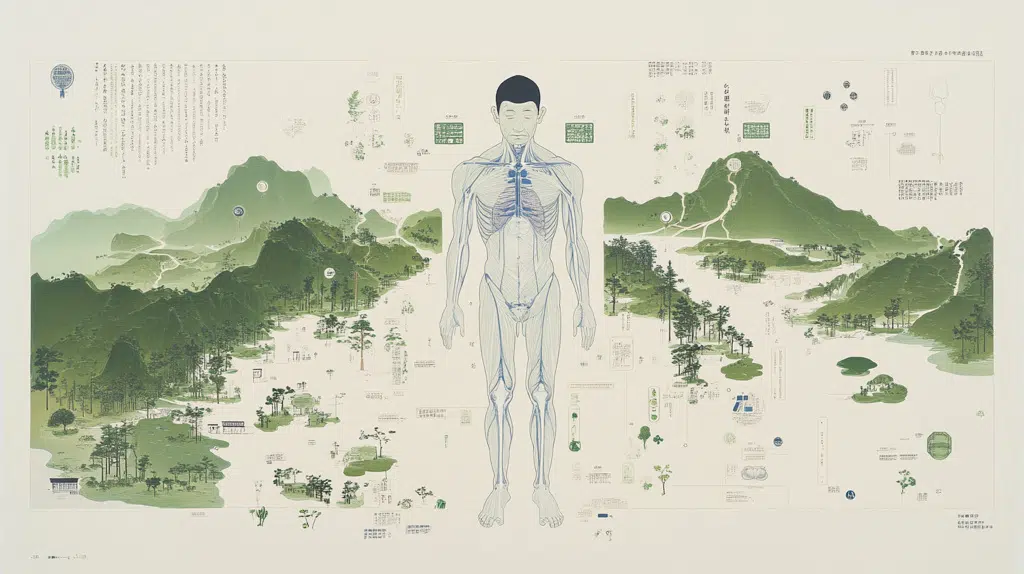
The figure is seated at the scale of the landscape, the mountains rising to shoulder height, the forests spreading across the lap and legs as terrain rather than drapery. The blue circuit lines run through the body and continue outward into the valley without changing register: the internal and the external on the same network, measured by the same instruments. A smaller seated figure appears in the hills to the right, a practitioner at human scale, which is the only way to understand how large the primary figure is. The Sungemite nodes are marked in blue at the organ positions and again in the landscape at the corresponding conductivity sites.
The surrounding text columns are running commentary, field notes and philosophical annotation held at equal weight. This is the archipelago’s most complete statement: the body, the land and the practice of attention as one continuous diagram.
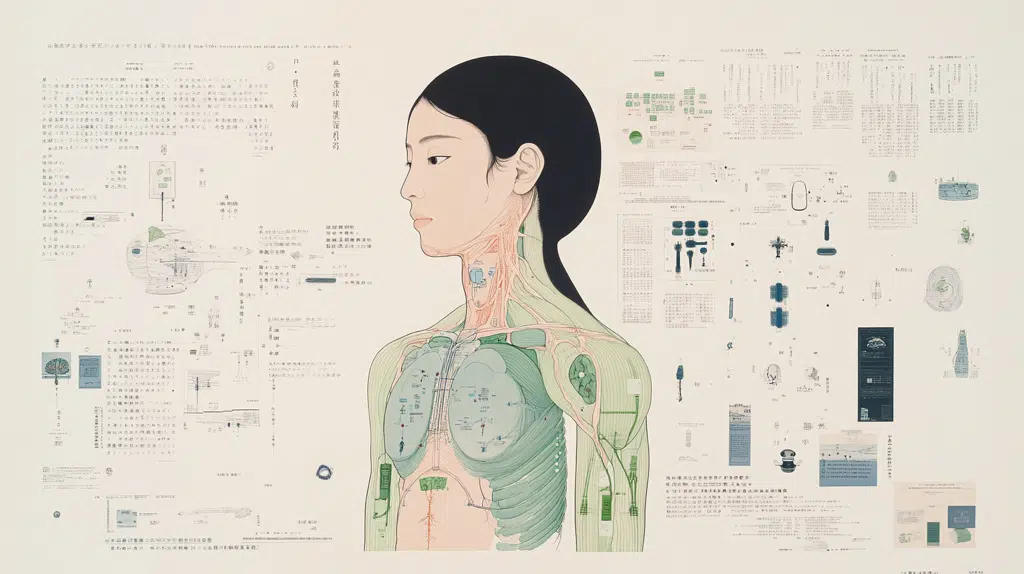
A transparency of the body rendered in the same green as emerald Sungemite, vascular and conductivity systems drawn without hierarchy, the mineral deposits mapped onto the organs as if the distinction between geology and physiology had never been considered worth making. The surrounding notations index instruments, dosages and seasonal variables. On the left margin, a small island diagram. The body and the terrain, again, on the same sheet.
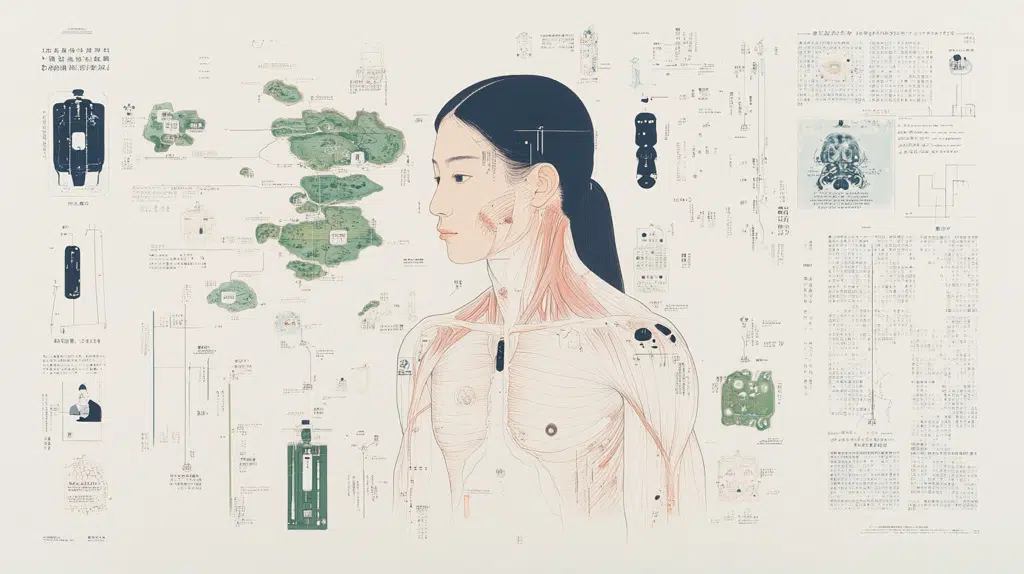
In the archipelago’s ontology, there is no prior unity that land, body and community are parts of. They are the same thing, expressed at different scales. The island does not sustain the body. The body does not inhabit the land.
The distinction was never made, which means it does not need to be overcome. What appears in these diagrams as a methodological choice, mapping terrain and physiology on the same sheet, is a direct consequence of a language and a thought structure in which separating them would be as arbitrary as separating a river from its current.
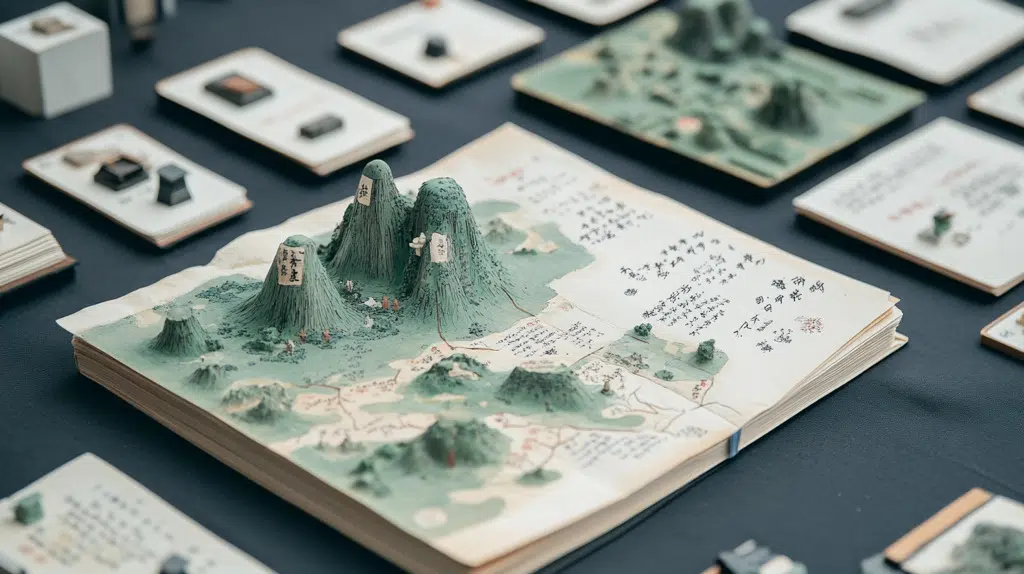
Some authors, at a point they choose themselves, stop writing a book and begin building it.Some authors, at a point they choose themselves, stop writing a book and begin building it. The text is already complete. What follows is a second work: cutting, layering, shaping the pages from the inside until the terrain described in the words rises off the surface as volume. It is a way of saying that the writing has gone as far as language can take it. The rest has to be held. No rule governs when this happens or whether it happens at all. It is a decision, made once, that cannot be undone.
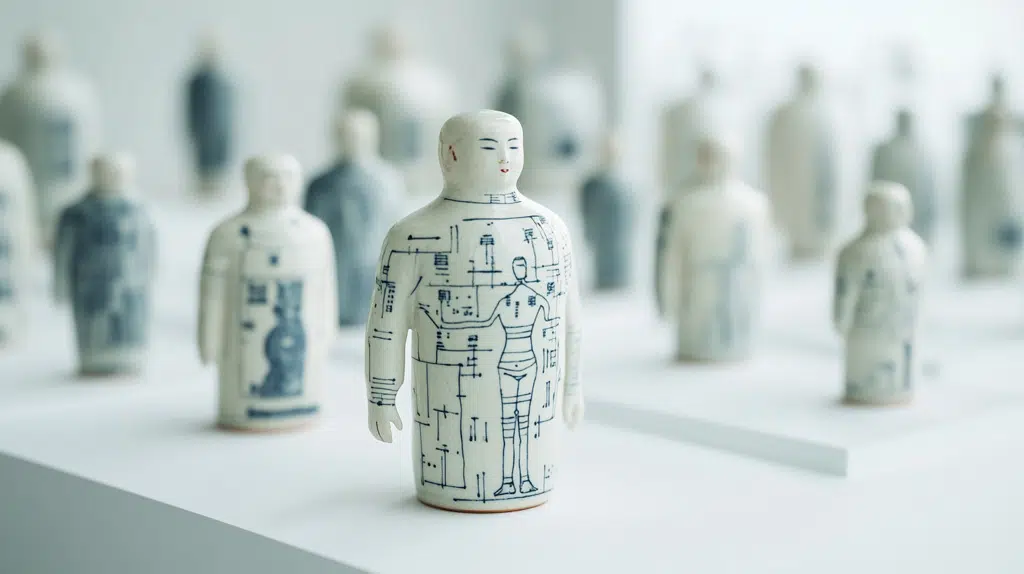
Ceramic treatment figures, mixed period, commons collection. Conductivity pathways and body maps fired into the glaze. Used for instruction, for diagnosis preparation and for the transmission of protocols between practitioners across islands. Each figure carries a slightly different notation system. No two are identical.
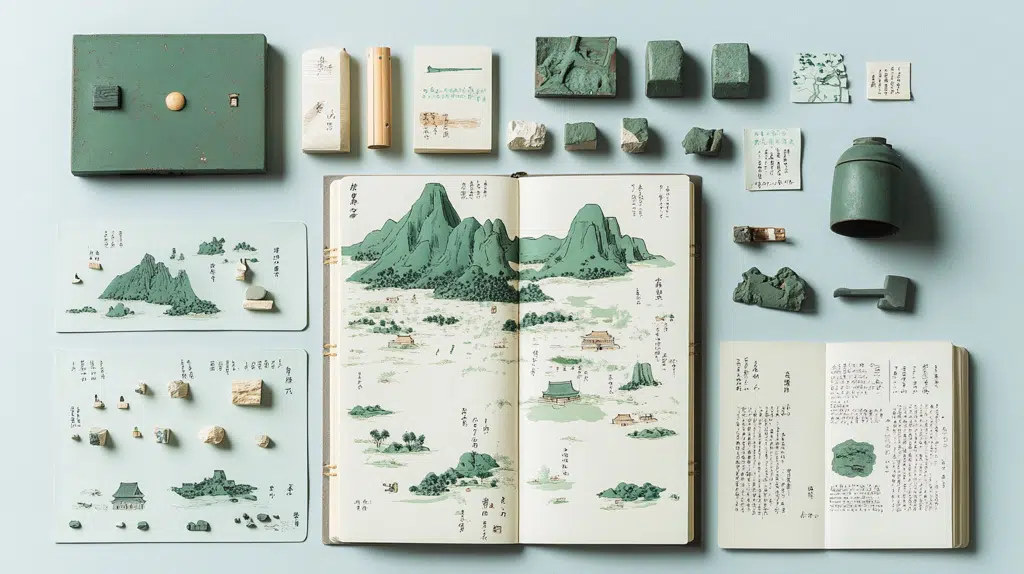
A working set, laid out for study. The central atlas maps the archipelago at the scale of a morning’s walk, settlements and peaks annotated in a hand that has been here long enough to have opinions about the terrain. Around it: Sungemite fragments sorted by provenance, small relief cards used for tactile cross-reference, a field journal open to a deposit notation, tools for marking and cutting.
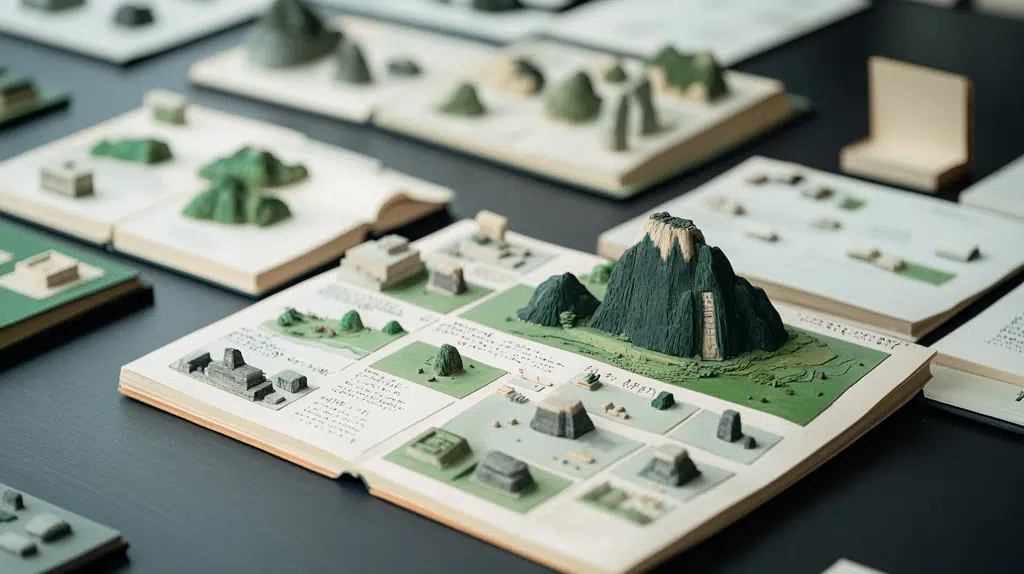
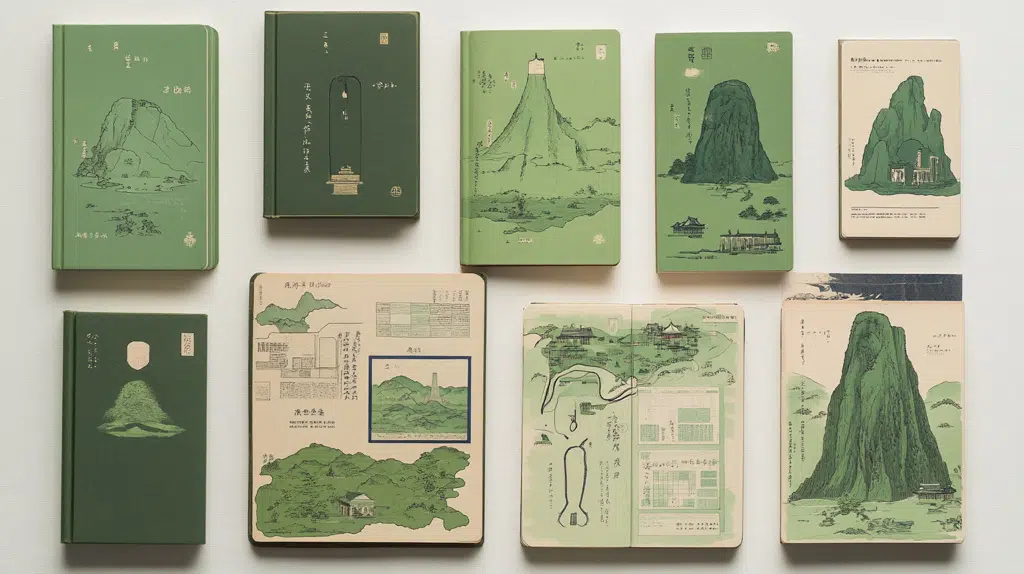
The Atlas of Remaining Forms. The text was finished. Then the author kept going. Each page now holds the volume that the words could only point toward: the central peak built up in layers over what the writing had already said about it, the surrounding settlements scaled to their relationship with the mountain rather than their physical size. There are twelve books in this series visible on the table. Twelve decisions, made once, that cannot be undone.
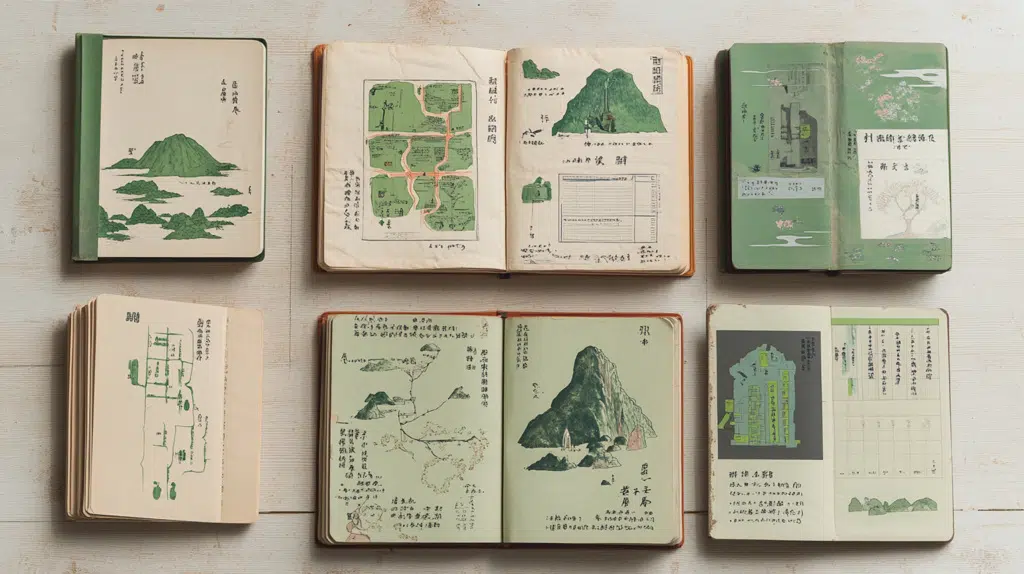
Personal field notebooks, six volumes, various hands, various periods. Each one a different relationship with the same terrain: path networks, rock formations, settlement edges, a single outcrop studied across seasons. The green of emerald Sungemite recurs in the pigments without apparent coordination between authors. Nobody decided that. It came from the same mountain.
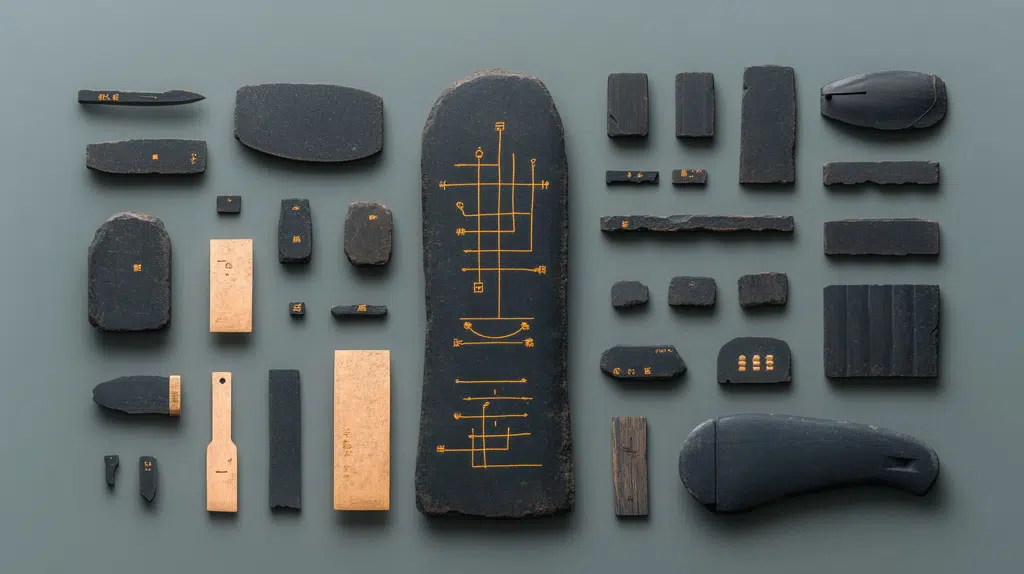
Dark Sungemite instruments and tablets, northern provenance. The central stele carries a full conductivity diagram in gold inlay, a map of energy as it moves through a system seeking equilibrium, not accumulation. The surrounding pieces are working instruments: some for the body, some for the terrain, the distinction less important than the principle they share. Energy here is more than a resource to be captured. A condition to be maintained, read and occasionally redirected when something has gone out of range. The pale wooden tablets on the left are calibration records. Someone was checking, not using, consuming, producing.
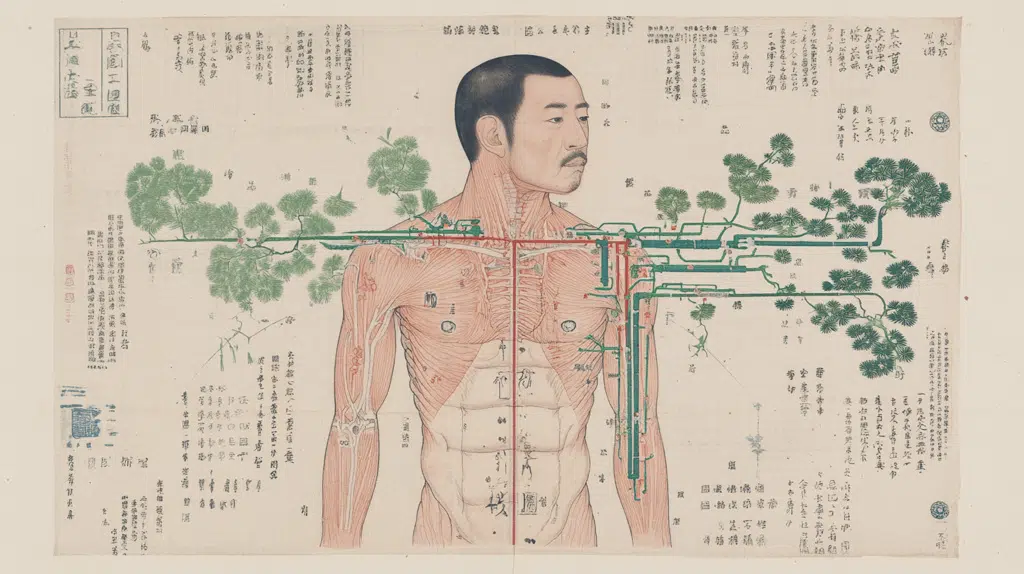
The body opens laterally into the forest at shoulder height, the pine root system and the muscle fiber continuing each other without interruption. The red and green lines are not circulatory or nervous in any strictly anatomical sense: they are conductivity pathways that the diagram tracks from the tree canopy through the shoulder joint and down into the abdomen, as if the body were a section of terrain the forest is still moving through. The margin notations are precise: pollen load by season, shoulder mobility measured against sleep quality, the correlation between specific wind patterns off the northern slope and inflammatory response in the upper body. The method is exacting. What differs from a clinical record is not the rigor but the frame: the patient and the pine forest are variables in the same seasonal equation, and the treatment adjusts when the wind changes.
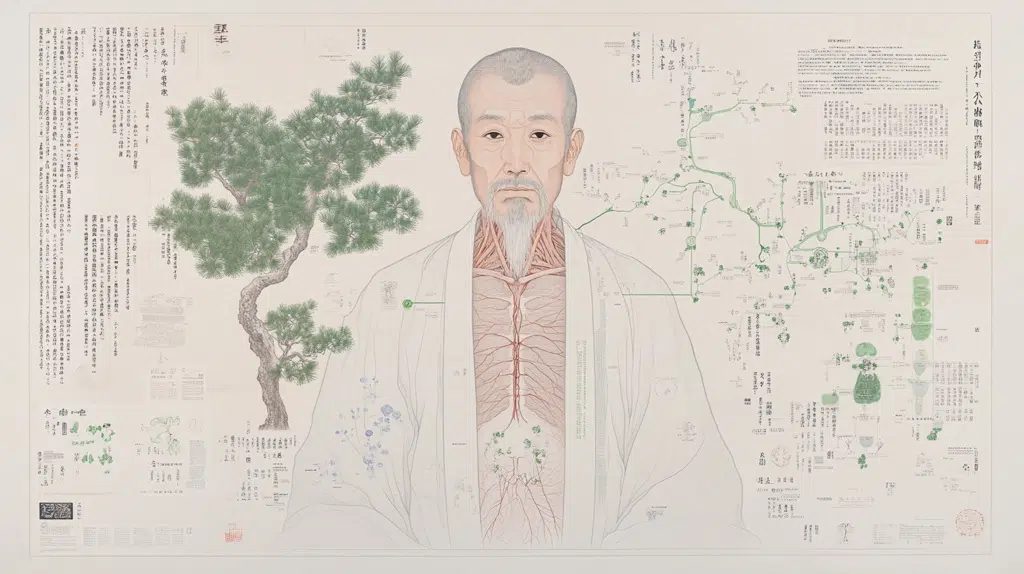
The vascular system descends through the chest and opens at the abdomen into a root structure that continues below the frame. The pine to the left is at the same scale as the man, drawn with the same line weight as the vessels: a compositional decision that is also an argument. The right panel maps a watershed, annotated with seasonal flow rates and Sungemite deposit locations along the banks. The green nodes mark where the water slows. They appear again on the chest, at the same intervals. The record is of one system observed from three entry points simultaneously: the tree, the body, the river.
Teaching set, commons at Shimahara. The standing figure maps conductivity pathways across the full body, the red lines marking active intervention points, the black indicating caution zones that require seasonal reassessment. The ceramic tablets around it are case protocols, each one a specific condition documented across multiple patients and multiple years. Students work with the figure and the tablets together, learning to read the body as a set of relationships rather than a set of parts. The dark Sungemite block at the back is the only piece in the set that is not explained to new students. They are told they will understand it when they need to.
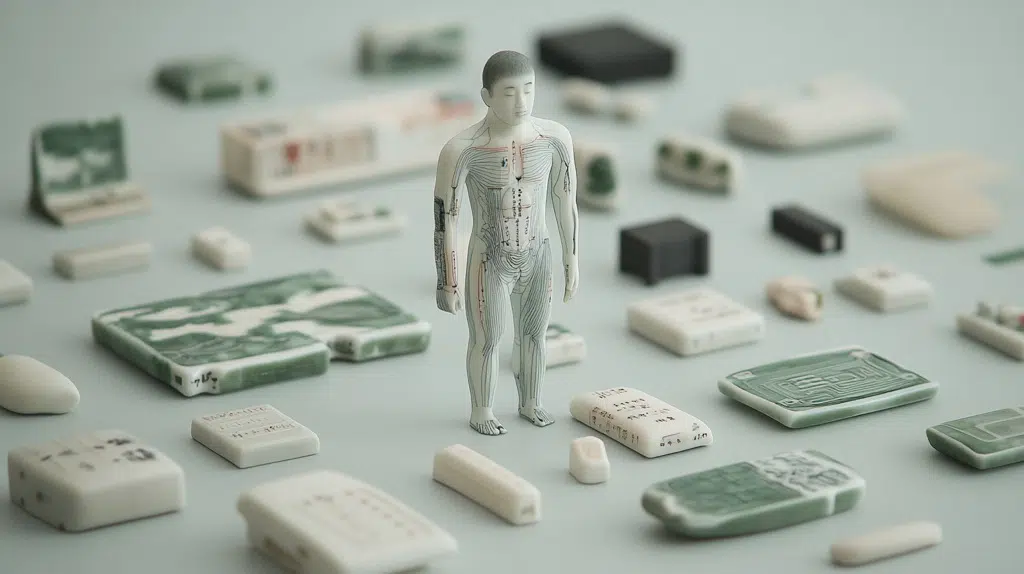
Teaching set, commons at Shimahara. The standing figure maps conductivity pathways across the full body, the red lines marking active intervention points, the black indicating zones that require seasonal reassessment. The ceramic tablets carry case protocols, each one a specific condition documented across multiple patients and multiple years. Students work with the figure and the tablets together, learning to read the body as a set of relationships. The dark Sungemite block at the back is the only piece in the set that is not explained to new students. They are told they will understand it when they need to.
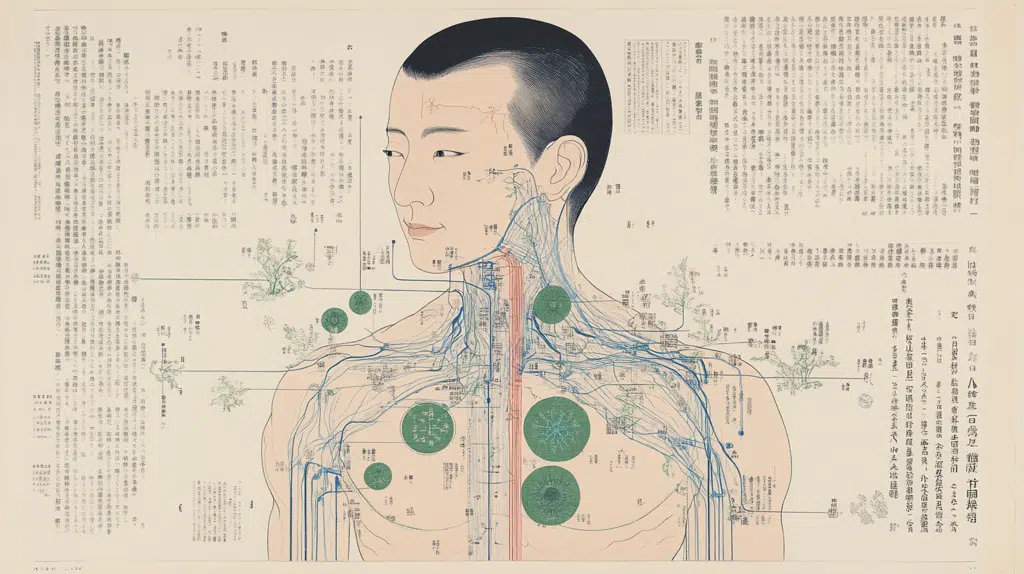
The green circles mapped across the chest are not organs. They are grove distributions, scaled to their canopy coverage and Sungemite proximity, overlaid onto the body at the points where respiratory and lymphatic function is recorded as most sensitive to seasonal forest change. The blue lines track both the nervous system and the watershed. The small botanical illustrations growing from the neck and shoulder are species whose pollen load, resin output and root depth are cross-referenced in the margins against the patient’s inflammatory history. Forest management and treatment planning are updated on the same seasonal cycle, by the same people, in the same meeting.
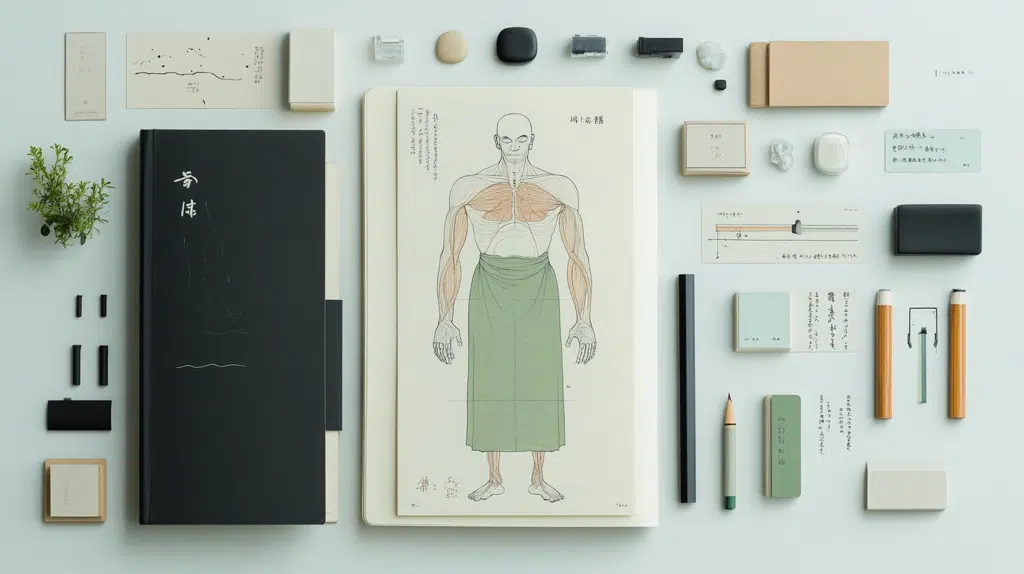
A practitioner’s personal kit, laid out in full. The anatomical chart is a working document: the notations at the base are session records, updated after each consultation. The dark Sungemite rods to the left are calibrated by weight and conductivity, each one shaped for a specific zone of the body. The green cloth carries no annotation. Everything else in this set has been marked, measured and cross-referenced. The cloth is just for sitting on. Some things are allowed to remain simple.
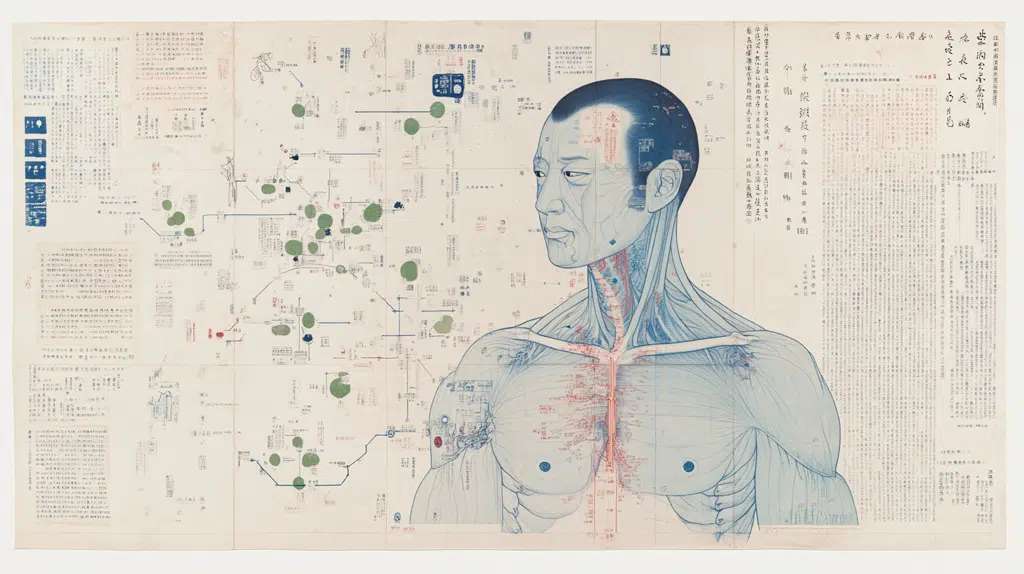
The green circles to the left are grove locations, mapped along a river network whose tributaries align with the blue lines crossing the throat and chest. The red marks inflammation points, recorded across three seasons. The blue dots on the chest are Sungemite contact sites, placed where the conductivity readings dropped below threshold during the period the upstream groves were thinned. The correlation was documented, added to the margin and flagged for the forest council. The body and the watershed are in the same record because they responded to the same event.
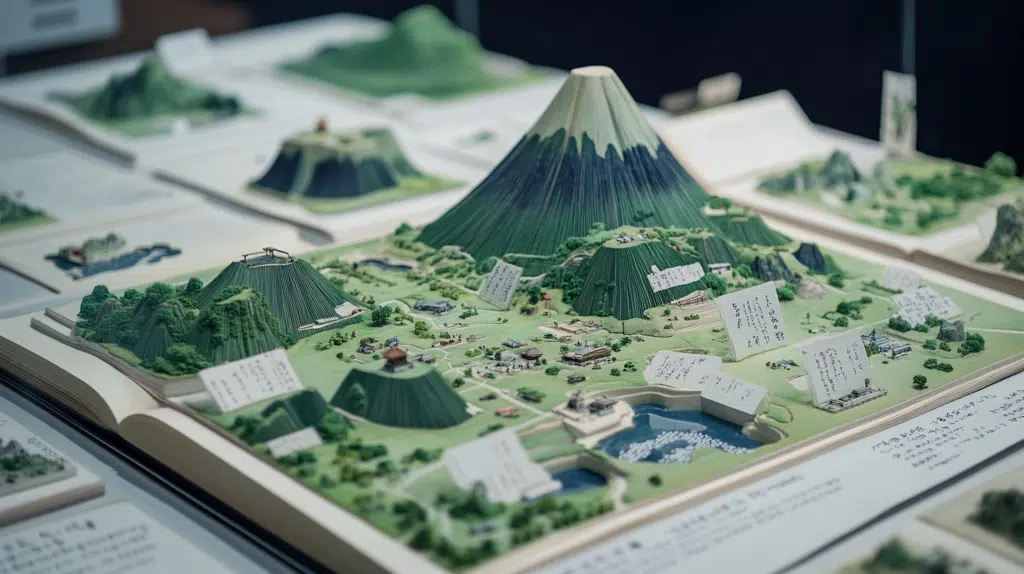
Mount Kymera, built into the page. The small flags mark active Sungemite deposits along the southern and eastern slopes. The lake at the base is a known conductivity site, where the mineral’s concentration in the water has been measured continuously for longer than anyone currently alive has been practicing.
The settlements are shown at the scale of their relationship to the mountain, which is not the same as their physical size.
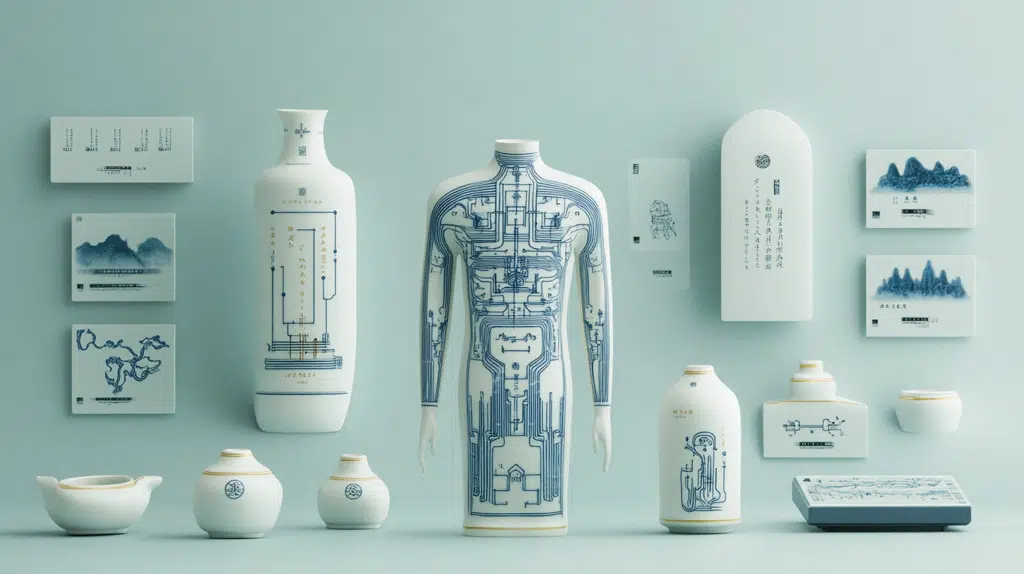
A recent commission from the Shimahara commons, made by a ceramicist who trained first as a practitioner. The central figure maps the full conductivity circuit in blue glaze, the pathways rendered with the precision of someone who has run a session that went wrong and needed to understand why. The vessels carry landscape notations: island outlines, watershed sketches, a tree rendered at the scale of an organ. The cards on the wall are field protocols transferred onto ceramic for permanence. This set will still be readable when the paper versions are gone.
A recent commission from the Shimahara commons, made by a ceramicist who trained first as a practitioner. The central figure maps the full conductivity circuit in blue glaze, the pathways rendered with the precision of someone who has run a session that went wrong and needed to understand why. The vessels carry landscape notations: island outlines, watershed sketches, a tree rendered at the scale of an organ. The cards on the wall are field protocols transferred onto ceramic for permanence. This set will still be readable when the paper versions are gone.
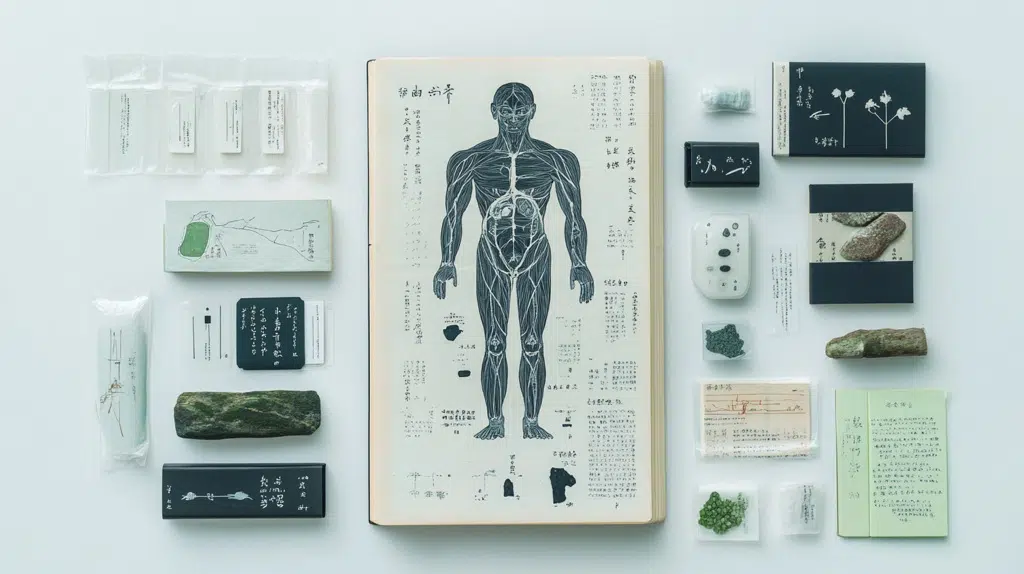
A practitioner’s full kit, laid out before a session. The anatomical journal at the center is the working document, annotated across years in at least two hands. Around it: raw and worked Sungemite fragments, sealed plant specimens cross-referenced to specific conductivity zones, field cards, a Sungemite contact instrument in white ceramic, session notes in a hand that gets smaller toward the bottom of the page. The emerald fragments in the lower right are the newest additions. Everything else has been used many times.
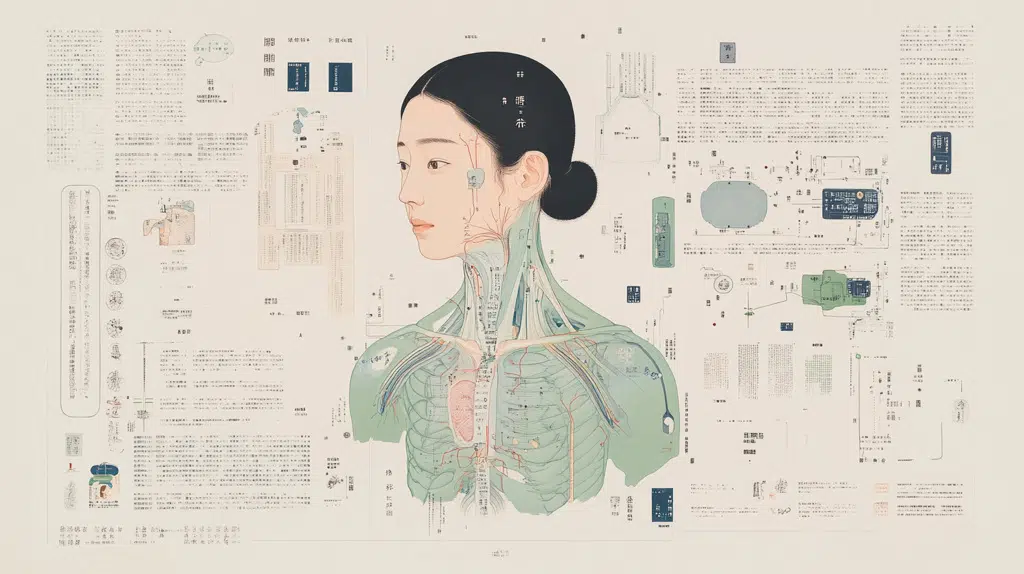
This is a self-portrait. The practitioner who made it mapped her own interior: respiratory system, lymphatic drainage, the Sungemite contact points along the jaw and clavicle she uses in her own maintenance sessions. The green wash is not a stylistic choice, it is the color of the mineral as it appears in the conductivity readings she takes of herself each season. The surrounding notations are her own case record. She is both the diagram and the one who drew it, which in this tradition is considered the most rigorous form of knowledge available.
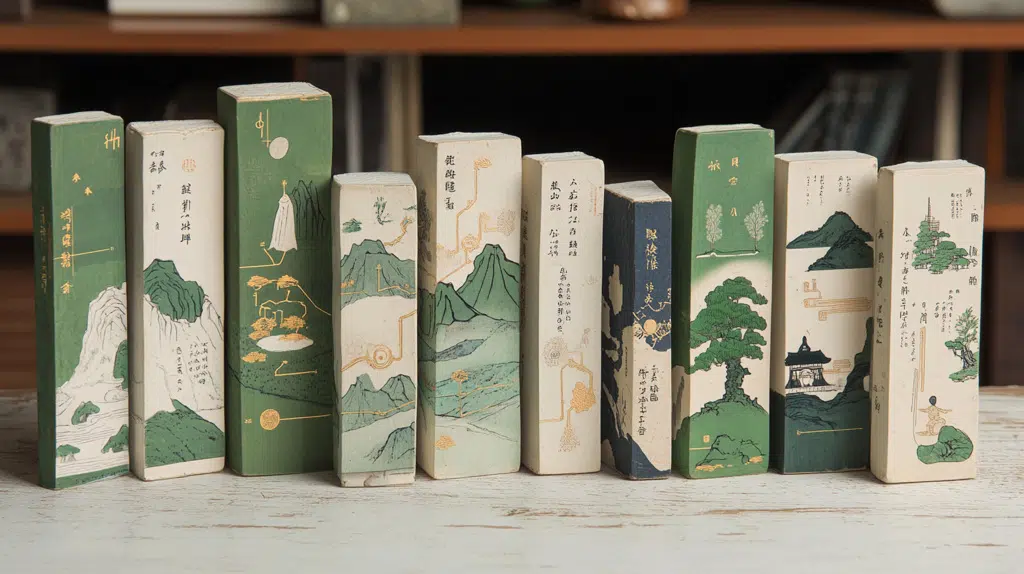
Incense boxes from the eastern commons, each one a landscape in miniature. The scenes on the spines are not only decorative: they indicate the botanical origin of the blend inside, the specific slope, grove or valley where the plants were harvested. The gold circuit lines on the third box mark a Sungemite deposit near the source site, included in the notation because the mineral’s proximity is considered to affect the resin quality of the trees growing above it. Burning these is also a form of reading the terrain.
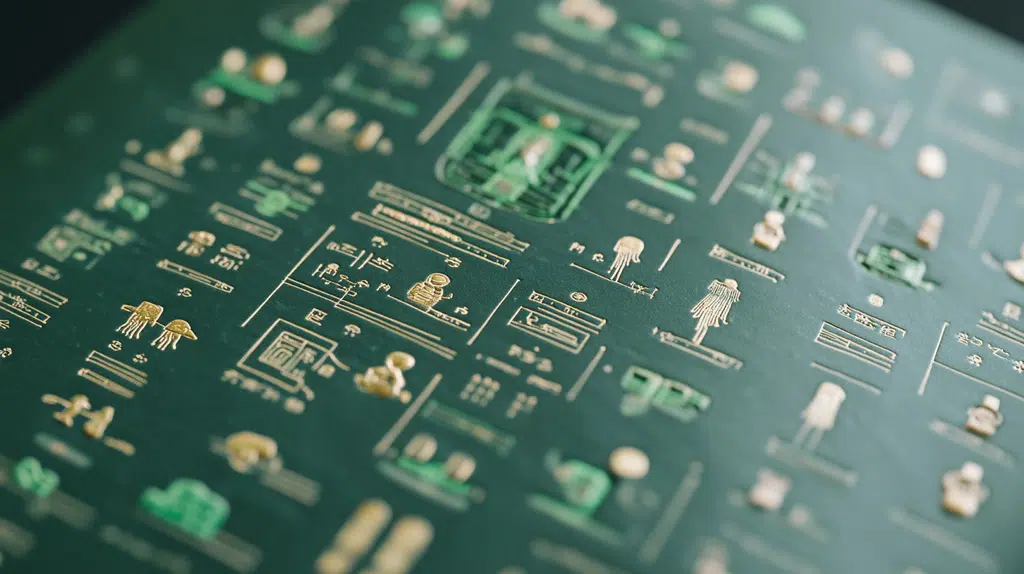
A Sungemite panel, emerald ground, gold inlay. This is not a scroll that is read left to right. It is a spatial document: each cell holds a figure, a sequence, a position in a treatment protocol and the reading moves according to the condition being addressed. The order changes depending on what you are looking for. Practitioners spend years learning to enter it at the right point. The gold figures are raised enough to be read by touch in low light or with closed eyes.
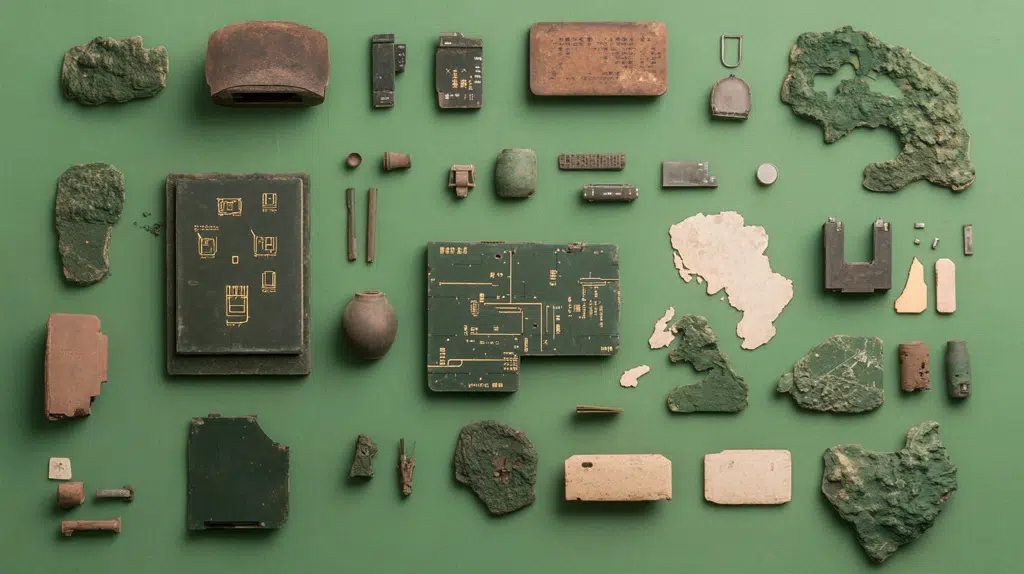
Field collection, mixed period and provenance: raw Sungemite fragments, inscribed tablets, working instruments, a ceramic vessel, two circuit panels in gold inlay and a paper island silhouette whose edges match no map currently held in the commons.
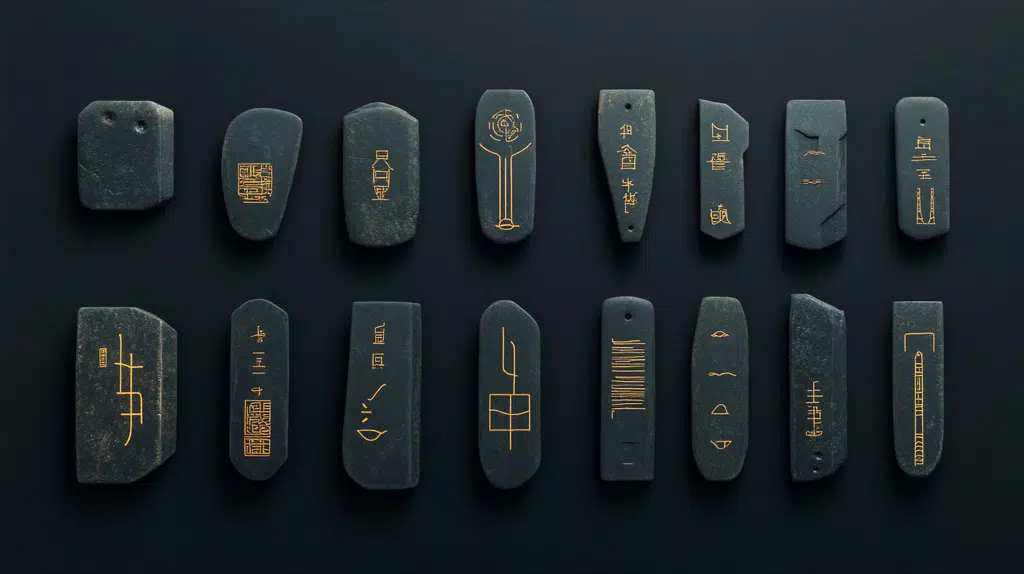
Fourteen dark Sungemite tablets, sacred collection. Each one was shaped from a single extraction, the mineral separated where it chose to fracture, the form accepted rather than imposed. The notations in gold mark what the stone already held: a conductivity threshold, a body position, a point in the terrain where the field shifts.
The meaning is structural, already in the mineral before the inscription, the gold tracing what was always there. The archipelago and the body are present in each tablet because they were never absent from the stone.
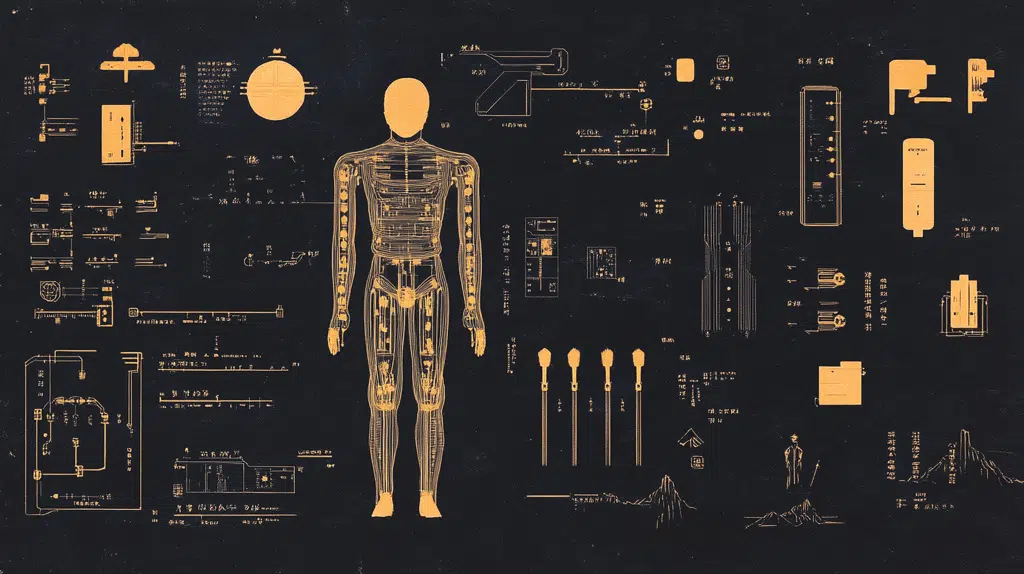
A full system drawn in gold on black: the body, the instruments, the circuit diagrams, the mountain reduced to a small sketch in the lower right corner as if to keep it present without overstating it. The Sungemite rods are shown at actual scale beside the figure, calibrated and numbered. The tone is technical throughout. What makes this sacred is not the gold or the darkness of the ground but the completeness of the attention: every element given exactly the space it requires, nothing elevated above its function, the mountain and the body and the instrument held at the same level of care. Holiness here is a quality of precision. The head carries no notation because in this tradition the skull is where the mountain thinks.The head carries no notation because in this tradition the skull is where the mountain thinks. The practitioner’s task is to become still enough to hear it.
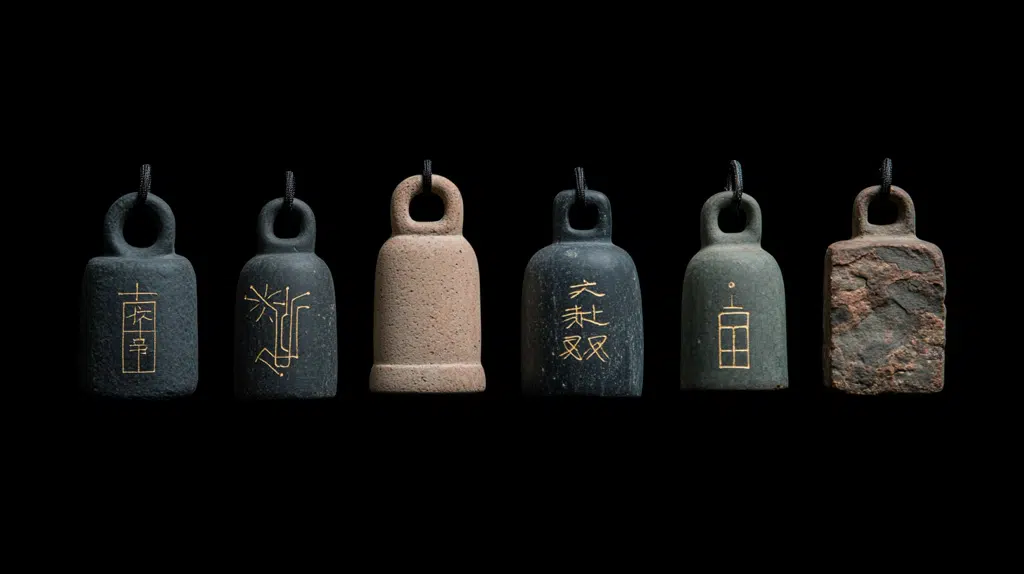
Six Sungemite wind tokens, worn at the body or hung at thresholds, each inscribed with the name of a wind the mountain has a relationship with.
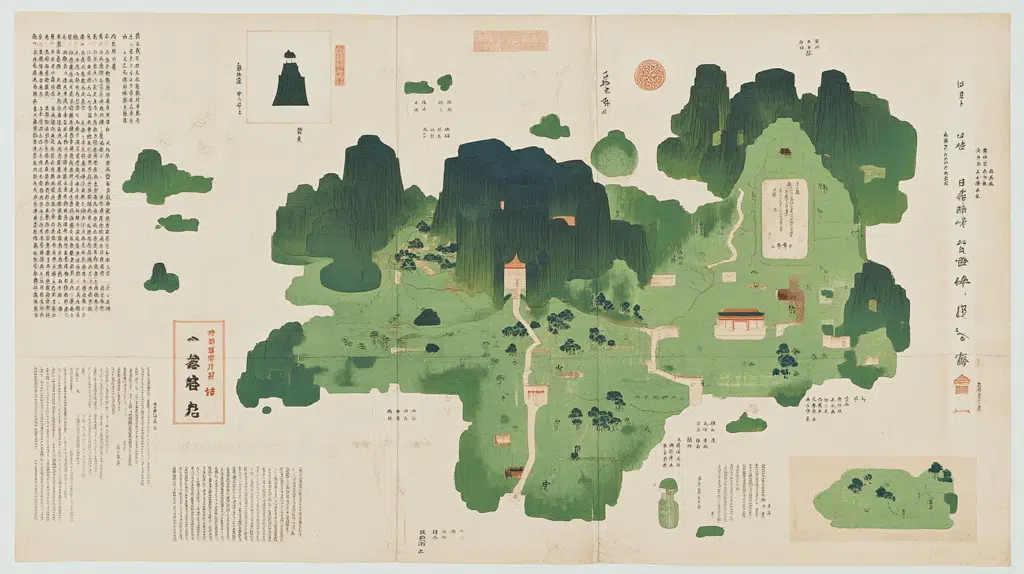
Island survey, undated. Terrain rendered by significance rather than dimension, Sungemite peaks dominant, settlements placed where the land agreed to receive them.
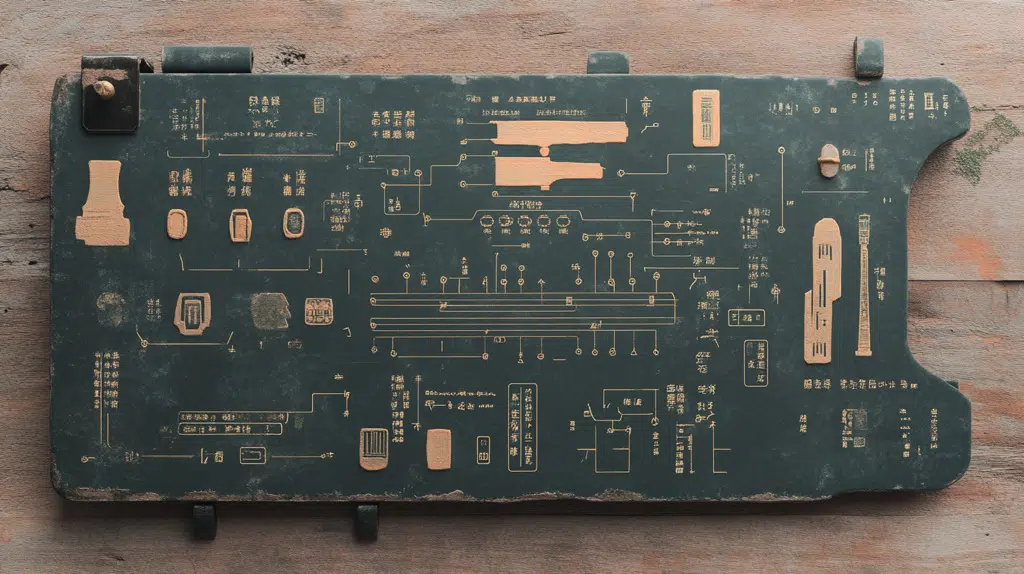
Island survey, composite authorship, post-contact period: the terrain mapped in two notation systems that never fully agreed and were kept that way deliberately.
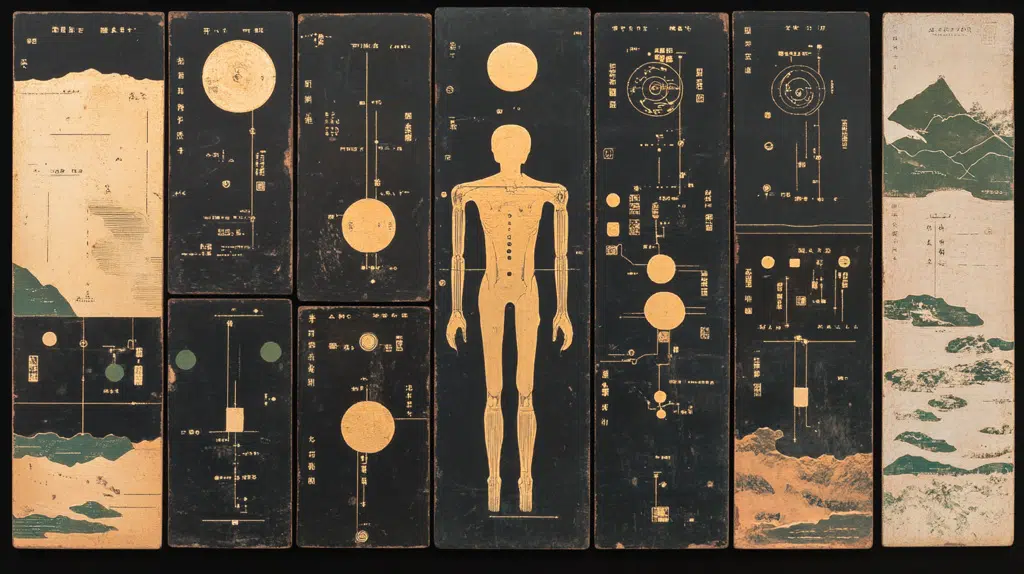
Seven panels, lacquered Sungemite ground: the body at center, celestial orbits to either side, the archipelago at the edges holding the whole system in place. The sun appears four times at different scales, tracking its relationship to the body, the mineral and the terrain across a single treatment cycle. The panels are read as a horizon, left to right, the way a practitioner reads a day.
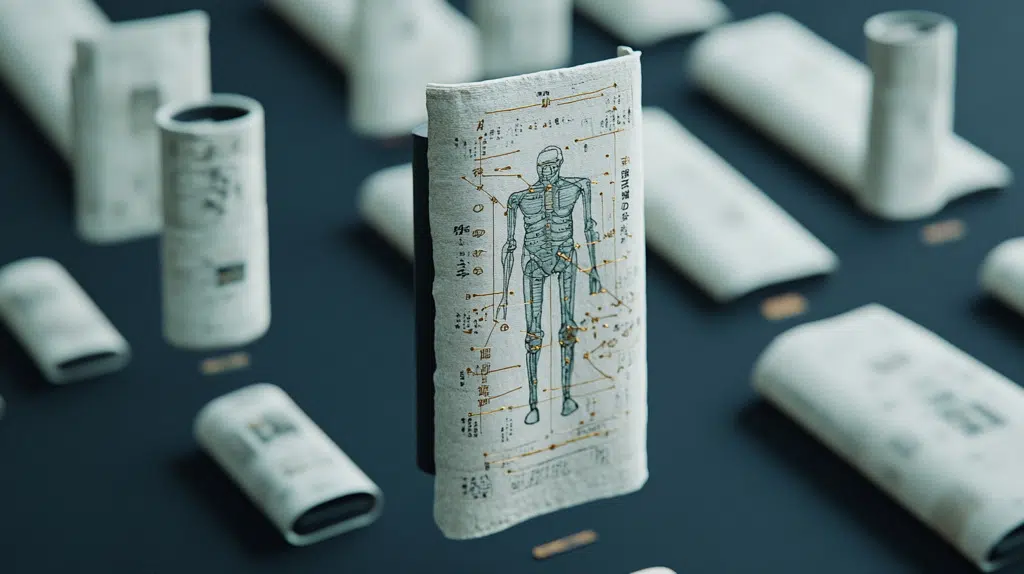
Sungemite storage vessels, field series. Each one carries the circuit diagram for the specific deposit the mineral inside came from, the mountain rendered on the right face at the scale of what a person can hold. The orange lines are extraction notations: how much was taken, what the site looked like afterward, when it was last visited. The vessel knows where it has been. That is considered part of what it contains.
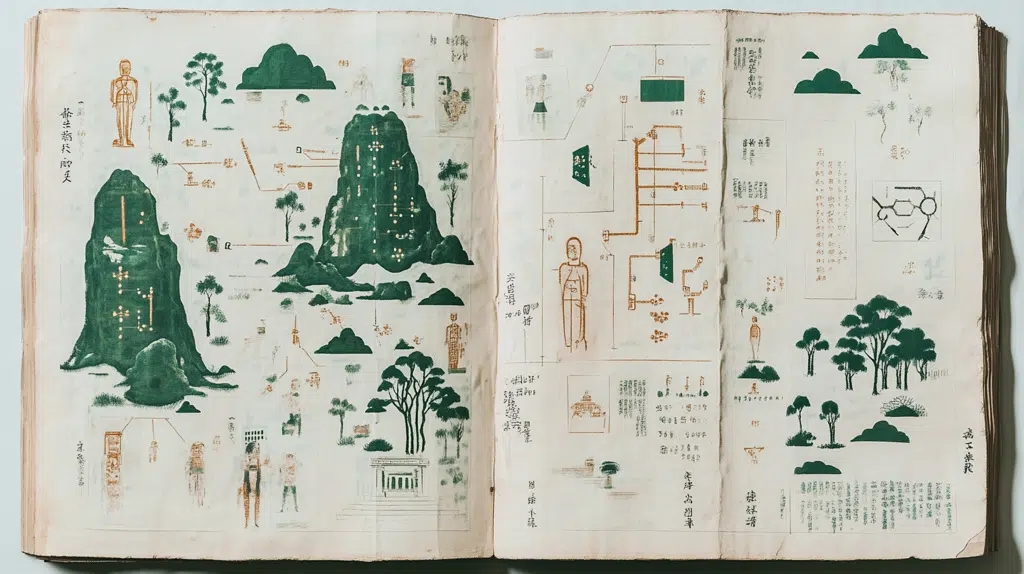
The Sungemite deposits on the left peak are marked in gold at the scale of a human figure standing beside them, which makes the mountain enormous and the deposits small and the figure smaller still. The right page works through the implications: what a body can do with what the mountain offers, given the trees, the season and enough patience. The whole book is an exercise in knowing your place without it being a defeat.
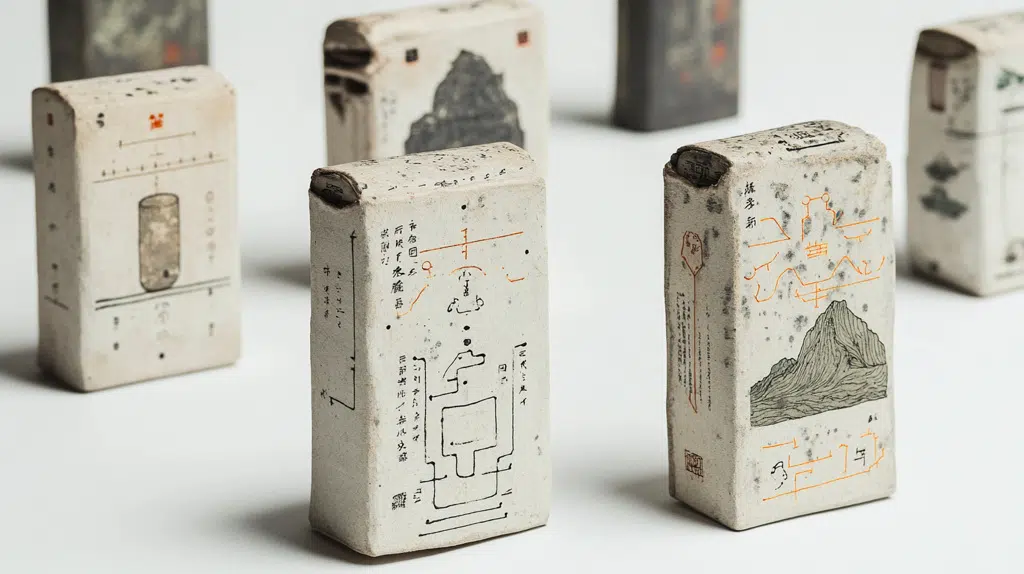
Sungemite field vessels, extraction series. The mountain on the right face is drawn at the scale of what the hand can hold, which is the only scale that matters here. The orange lines record what was taken, when, and what condition the site was in afterward. The body diagram on the front is the intended destination of the mineral inside. Origin, transit and purpose on the same surface, in the same hand, made before the journey began.
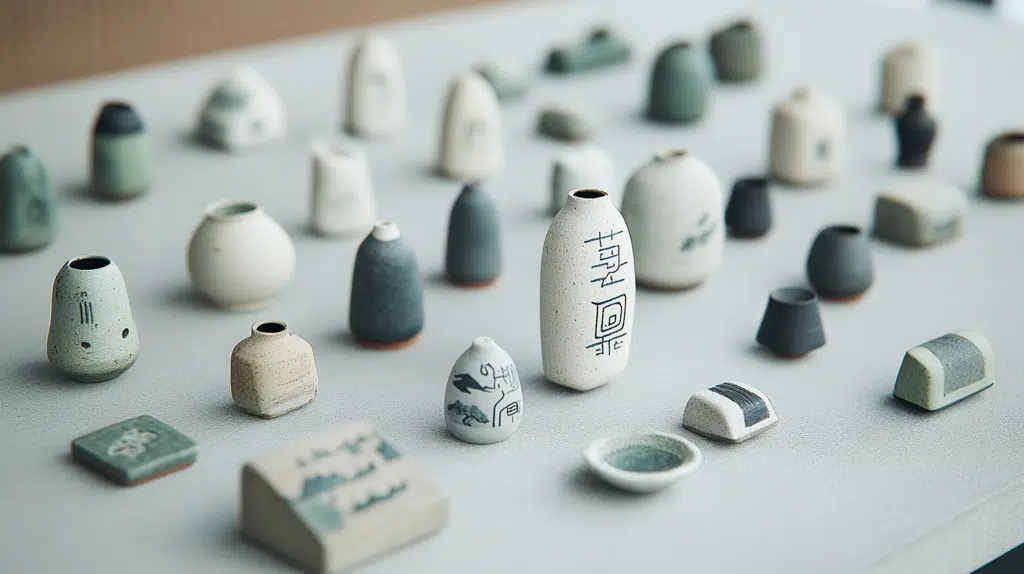
Personal vessels from the northern settlements, each one made to be held in one hand. The forms follow no single convention: some carry notations, some carry nothing, some carry a landscape so small it requires stillness to read. They are made throughout a life, given, kept, passed on. The ones with no markings are not unfinished.
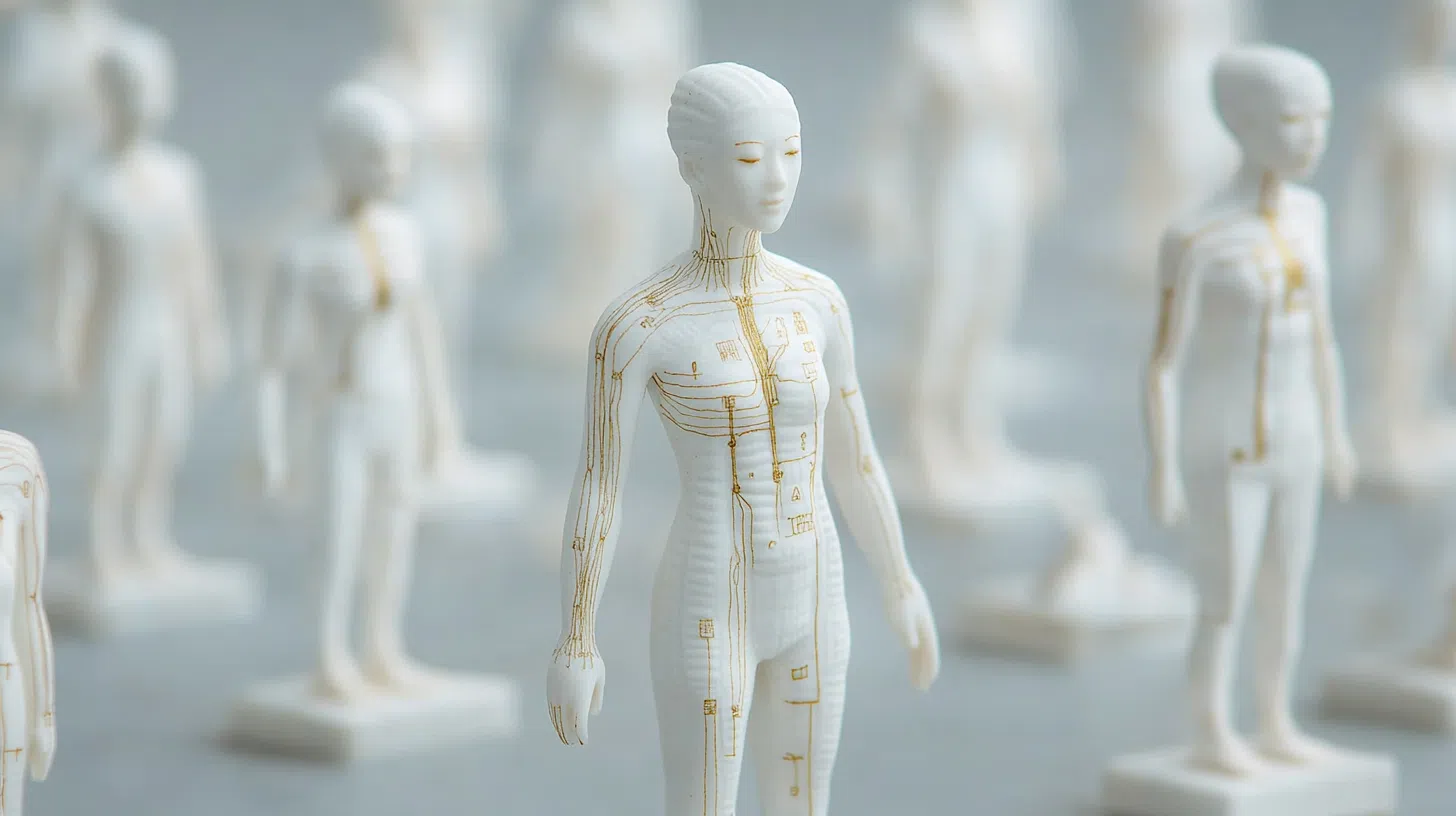
Treatment figures, female corpus, Sungemite gold thread inlaid into white ceramic. The conductivity pathways mapped here are specific to this body and to the knowledge that every person who has ever arrived on this island came through one. The figures stand at slight angles to each other, each notation system a variation on the same understanding. The commons holds forty-three of them. They are the most consulted objects in the collection.
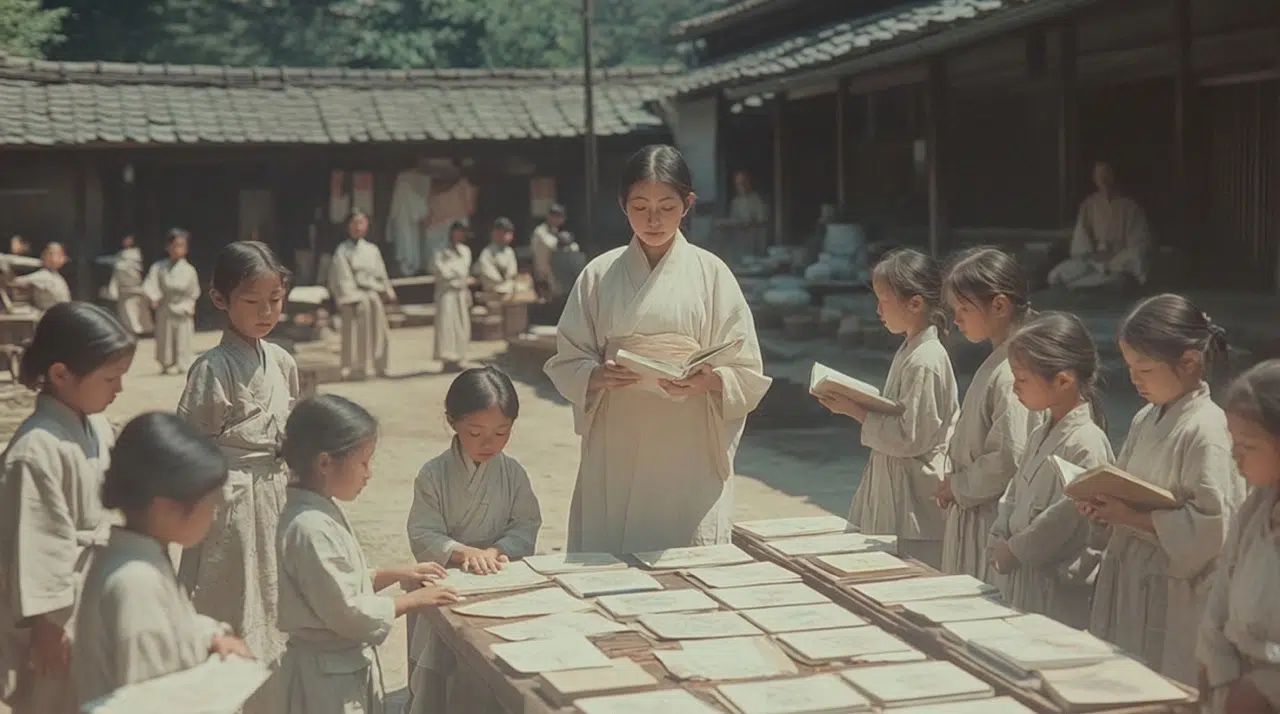
Morning session, open courtyard. Each child has brought a map and a name they invented for something on the way here. That is where the lesson starts.
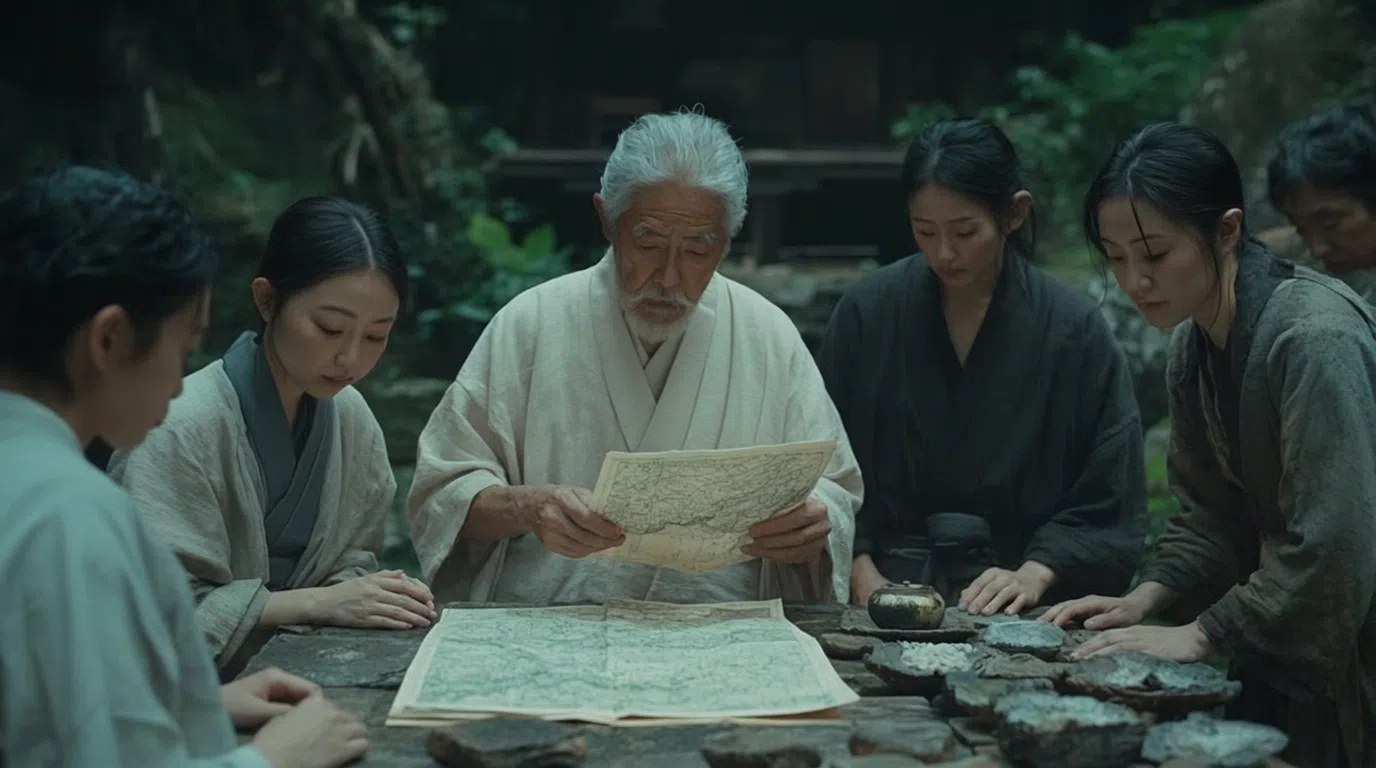
Hiro Manu Okada, late session, garden table. He holds the map the way someone holds a letter they have already read many times and are still not finished with. The Sungemite fragments along the table edge are his, sorted by a system nobody else fully understands and he has never written down. He has been wrong twice in forty years and remembers both occasions with more precision than his successes. The others at the table are not students. They are the people the archipelago sends when something has gone beyond the capacity of the current generation to read alone. He does not tell them what to think. He holds the map until they see what he sees, and then he puts it down.
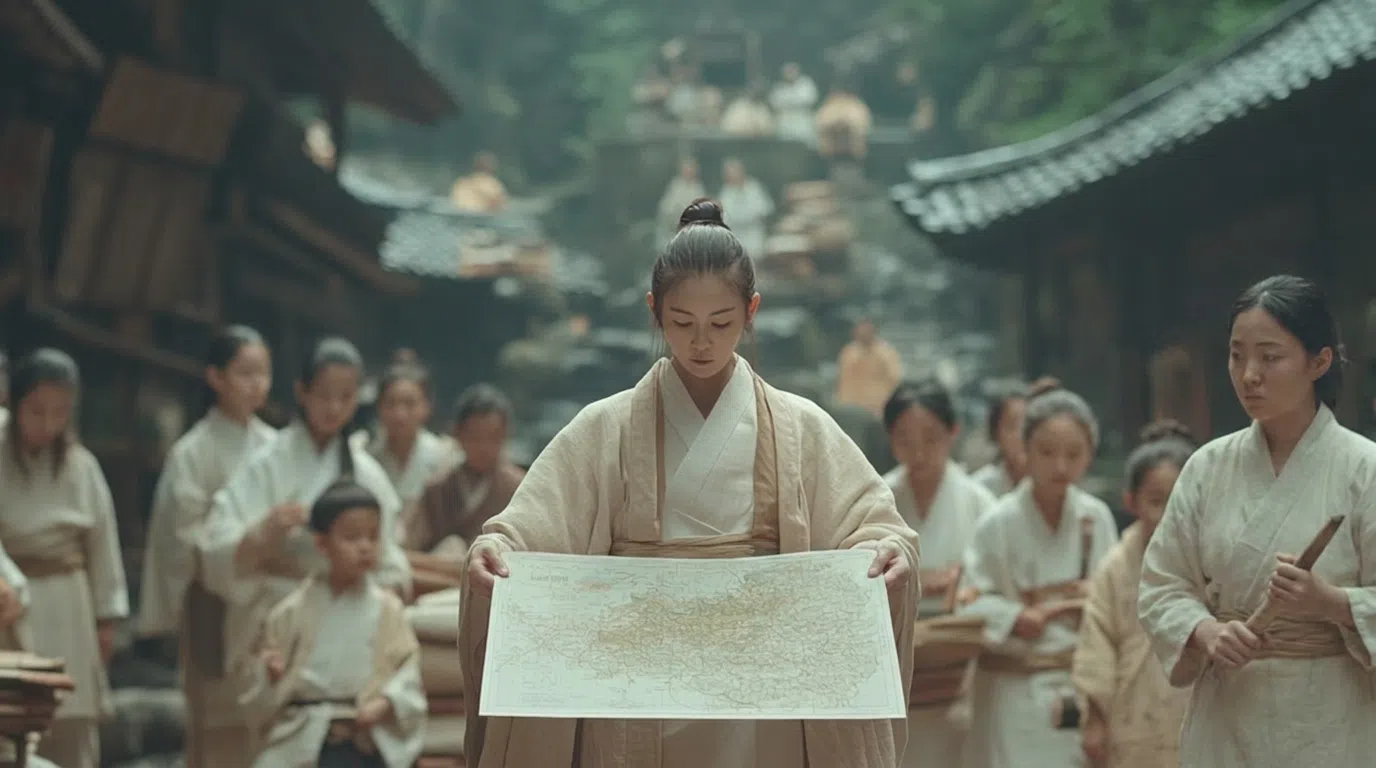
The map is held at reading distance. She is finishing her own reading of it before she speaks. What she does is called complexity listening in the commons: arriving at a situation with a map that is already partly wrong and using the discrepancy between the map and what she finds to locate where the system has shifted. The village called her because something changed and nobody could name it yet. She will name it by the end of the day.
Her authority comes from a process the archipelago runs every seven years: a period of collective silence followed by a single day of open nomination, then a walk. The community follows whoever moves toward the hardest problem without being asked. She has been followed three times. Her function is to go where the system has stopped making sense to itself, read the terrain against the accumulated maps, and say plainly what has shifted and what the community has been avoiding knowing. She holds no permanent office. She can be accompanied, questioned and contradicted at any point. What cannot be taken from her is the walk.
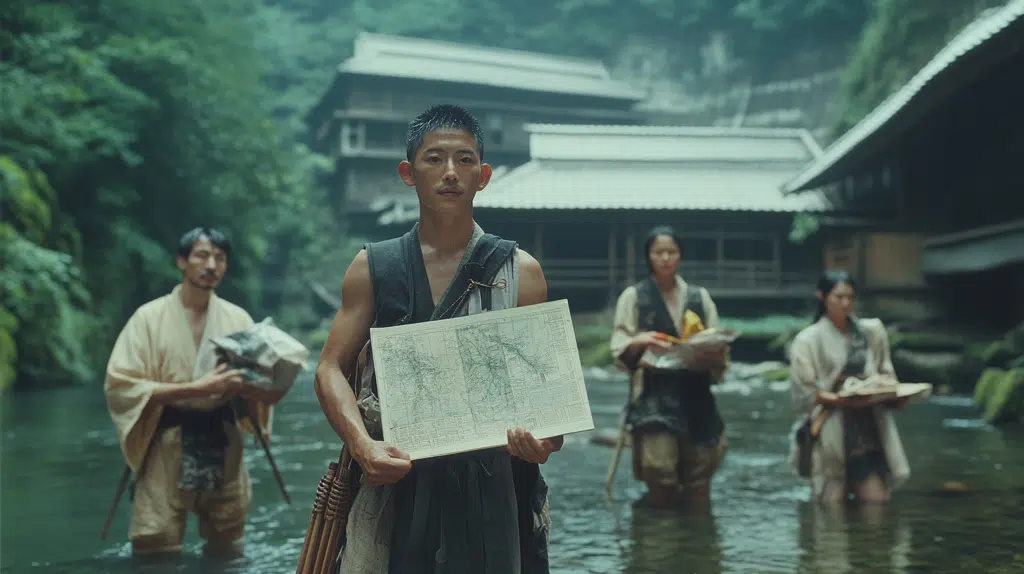
A river renaming team, mid-process, second year. The map held at the front carries the current name alongside the two provisional names proposed in the first season, neither of which survived contact with the water in summer. Renaming a river takes three years because a river has to be crossed in every condition before a name can be trusted to hold. They are standing in it now because this is also part of the method.
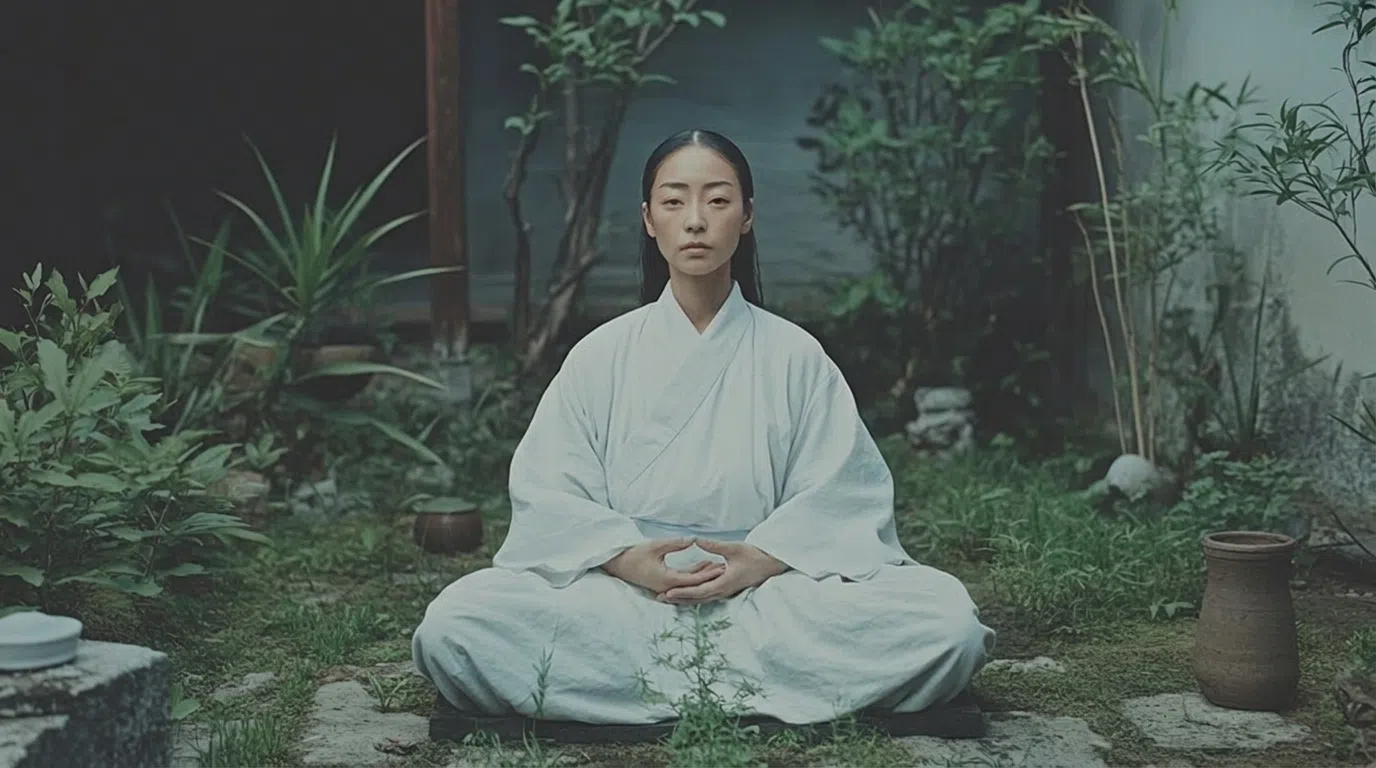
Nami Ishida, Umikaze, garden court, early autumn. She holds a small Sungemite fragment in both hands, the seasonal naming posture. Each year the community waits for her to sit like this before the name is considered ready. She does not announce it. She sits until the season tells her what it has decided to be, and then she speaks it once. This year’s autumn has been unusually slow to declare itself. She has been sitting for three days.
Nami Ishida works from a position she has never named and refuses to systematize. She selects from traditions the way a field practitioner selects instruments: by what the problem requires, by allegiance to the problem itself. Zen stillness, Polynesian wind reading, the seasonal logic embedded in the Sungemite conductivity cycles, the older cartographic methods she inherited from the Shimizu tradition and then quietly dismantled and reassembled. She kept the protocols. She discarded the cosmologies.
What makes her seasonal naming different from ceremony is that she treats it as a problem of precision. A season has a structure that precedes its name. Her work is to find the name that fits the structure already present. She sits with the Sungemite fragment because the mineral responds to the same variables the season is made of: moisture gradient, electromagnetic field, temperature differential between slope and valley floor. She is calibrating.
Whispers & Giants
20025-2026
Note
This project began with a simple proposition: that a generative image model, given a coherent enough ontological frame, will produce evidence of a world it has never seen but somehow already contains.
The prompts were research questions. The images that came back were field documents from a civilization assembled out of latent sediment in the training data: centuries of East Asian material culture, medical illustration, cartographic tradition, craft epistemology, recombined into something that has never existed but carries the weight of things that have.
The gap between what was asked and what arrived is where the imagination lives, and where the ethnography begins. What I was testing, across this session, is whether AI can be a genuine collaborator in speculative world-building, one that holds ontological complexity without collapsing it into decoration or mysticism, the two failure modes of this kind of work.
The result is a civilization that neither the AI or me could have built alone, which is the most interesting thing AI can do for imagination.